Showing posts with label Jain temple. Show all posts

Tuesday, July 29, 2014

The Cave of Sittanavasal Hill - Monks' Retreat at the Fringes of Pudokottai, Tamil Nadu (India)


Somewhere in nowhereland called Trichy in South India, I decided to head deeper into the desolate plains 38 kilometers by bus to Pudokottai. Pushing the so-called envelope, I hopped into another bus and traveled 20 kilometers further. I was forewarned by my readings never to head into Sittanavassal alone. There were anecdotes of muggings on solitary visitors and these fleetingly gave me goosebumps. However, goosebumps never stopped me before. That late afternoon, I found one of the last buses bound for Sittanavasal for the day, albeit my last chance to discover for myself a road less taken in that area.

I wasn't going to town. But to an outlying cave turned into a temple.

It was late. The sun had graduallly slid in the horizon; its existing light providing a hypnagogic overlay in the surroundings. I asked the driver's assistant to inform me when I am in the area already. Then I hopped out of the bus and found myself morbidly alone on a steppe with nothing but shrubs, rice paddies, a pond littered with lotuses, and from a distance a hill with a cave - the Cave of Sittanavasal Hill.

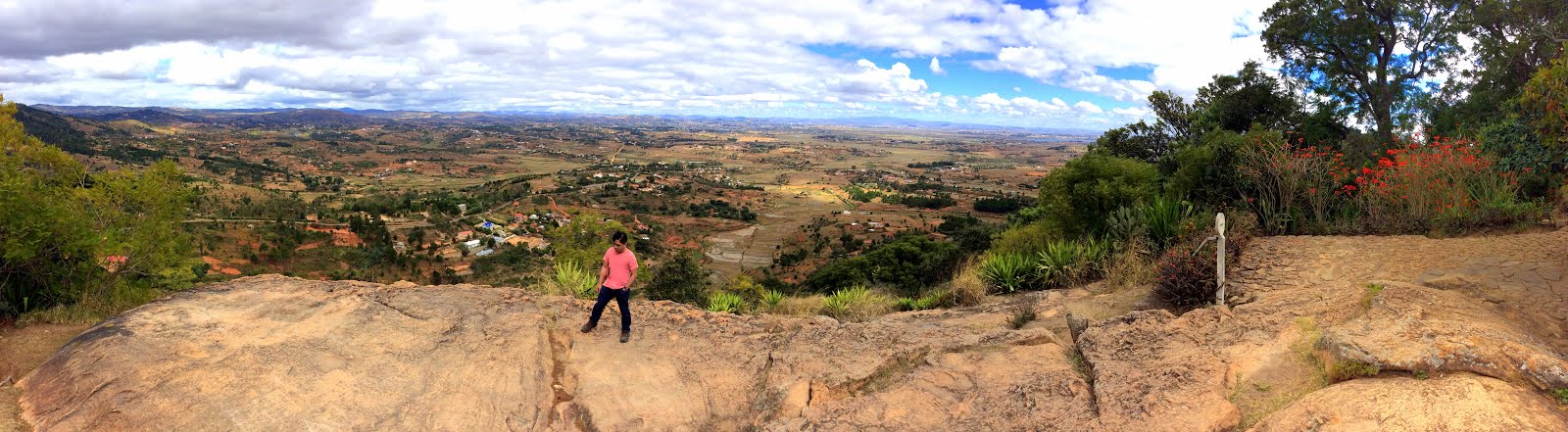
I walked up the hill to find a cave where meditating monks take shelter. There was no elaborate temple to speak of. The famous Sittanavasal Jain Temple is located elsewhere at the town proper further north. This was just an empty cave on a considerable elevation, with a breath-taking view of the green valley below.

En route to the cliff, I heard voices. I realized I was not alone. I had mixed feeling about this, anxious even. They could be the heel and anti-heroes I was duly warned about - and I could be in trouble! Or they could be hospitable locals. I crossed my fingers. And guess what: six Tamil students were on their way to visit the cave temple. I gainfully acquired 6 new friends and protectors who acted as though I was a guest in their own abode. In principle, I was. More than anything, I was thanking the heavens to be in their kind company in the midst of the distant heath.


"Sittanavasal", the conspicuously tongue-twisting term, is a word play of a Tamil word that meant "abode of great saints". Sittanavasal Cave - aka "Arivar Kovil" - has a long and rich history behind it. Try 7th century, when it had been ascribed as a Jain Temple; a marbly rock west of the stony mound, excavated in a bluff. The monks (with nothing but their robes) would sit, cogitate and sleep on the slippery floor of the cave - to meditate, pray for enlightenment and attain nirvana. Unfortunately for me, the cave was deserted at the time of visit. I couldn't get near the interiors said to be inundated with fresco-secco art. There were protective bars probably meant to discourage prospective vandals.

The hike up the hill wasn't a walk in the park. In no time, I was drenched in my own perspiration. In contrast, my new found friends didn't even break into a sweat. How embarrassing!

There were minor concavities and colorful altars of elephants, horses and goats nearby. The sprawl of the fields yielded not a single dwelling. The place felt like a "wild south" if there ever was one in India. By the time we got back to the deserted highway to wait for our bus, the last few gasps of sunlight have but dissipated into the darkness.

I rode back in introspective silence towards Pudokottai to catch my night bus back to Trichy. There was something immensely satisfying with what just transpired. As an added bonus, the guys - who were still practically strangers - decided to pay for my bus fare. For all intents and purposes, I am far from being a pauper, but financial capacity hardly plays into the hospitality of people or their generous culture. How's that for an all-inclusive adventure? How lucky could I get?

This is the Eye in the Sky!

View from the rocky cliff - the western plain of Sittanavasal Hill.

Well polished stone beds or Ezhadippattam (aka Jaina beds) used by Jaina ascetics. There are Tamil Brahmi inscriptions (as well as vandalisms) written on these rock beds. On one of these beds, sallekhana - "fasting unto death" - has been performed. Ouch.
My protectors, guide and friends from Pudokottai.


The climb up this slippery, uneven hill to get to the westward cave.

Wednesday, October 24, 2012

Jain Temples of Jaisalmer Part 1 - Rikhabdev and Chandraprabhu Temples


Tucked in the westernmost Indian city of Jaisalmer, within the bastions of a “living fort” is an array of Jain Temples of exquisite beauty. Jainism, an Indian religious denomination that came into being between the 9th and 6th century BC, prescribes a path of non-violence towards living beings. As a religion, it subscribes to the practice of several vows: non-violence (ahimsa), truthfulness (satya), non-stealing (asteya), celibacy (brahmacharya), and non-materialism (aparigraha). This has amassed a following of approximately 6 million worldwide.

Within the sturdy walls of the Jaisalmer Fort, seven Jain Temples stand amidst time-worn, narrow alleys. The temples are rather small compared to many temples we’ve seen in our travels, but they’re among the most intricately designed artworks; engaging in their soft and warm hues of yellow sandstones; lush in ambitiously calculated geometrical patterns and lavish in artistic grandeur. These temples are dedicated to the Jain hermits (tirthankar).

Most of the temples are situated beside each other, mostly without English signs. In entrances are reminders not to “tip” the Holy Men (“place them instead in donation boxes” reminded one). Leathers of any kind, except those that are part of a musical instrument, are not allowed anywhere within the temples. Main altars, found in inner sanctums, are strictly for “worshippers” only, thus there were parts of the temple I couldn’t see – but these are few. Most of these temples have limited viewing time, mostly in the morning before midday. I had to pay an entrance fee of 30 rupees and a camera fee of 70 rupees. Video cameras fetch higher rates at 120 rupees. These days, an all-in rate of 150 rupees is asked from visitors.

For completion, here are the seven temples at the fort: Chandraprabhu, Rikhabdev, Parasnath (with its beautiful “torana” or gateway), Shitalnath, Sambhavanth, Shantinath and Kunthunath.  In this post, we shall focus on two of them: the Rikhabdev and the Chandraprabhu Temples, the first two temples visitors are likely to check out first.

I proceeded to Rikhabdev Temple when I saw a big group enter Chandraprabhu. Rikhabdev boasts of beautiful sculptures framed with apsaras (celestial maidens), adorning the pillar walls. It’s easily navigated because there are only four narrow hallways in its rectangular room. I was, of course, tempted to trespass the inner sanctum. These nooks rankle with a sense of mystery for an outsider like me. 

Continued below…


RIKHABDEV TEMPLE


CHANDRAPRABHU TEMPLE


Chandraprabhu Temple has affinity to the concept of the moon, the symbol associated with the eighth tirthankar – named Chandraprabhu - for whom this temple is dedicated. Reference to the moon has something to do with the holy man’s conception - or is it gestation? The story itself, fashioned like a fairy tale, is fascinating. According to legend, one day the queen was looking at the glowing full-moon all of a sudden, she had a strange desire to drink the glowing streak of moon light. The king cleverly managed to satisfy this strange desire of a pregnant mother. On the thirteenth day of the dark half of the month of Paush the queen gave birth to a healthy son who was fair and glowing like the moon. The name literally means “glow of the moon”.

The temple has an imposing exterior. Inside, you’re ushered into a two-story complex punctuated by the main altar that houses a white marble Buddha. Similar forms characterize the surroundings. The ceiling has an ornately sculpted design that reflects most of the balustrades, pillars, and arches in the circular hallway. I imagined an intimate amphitheater where performers could dance and sing at the central hall while an audience stands looking down from the upper level – but then this was designed as a temple, not a theatrical venue. The things your mind conjures when faced with boundless beauty.

This is the Eye in the Sky!


The local tourists contribute to the fascination in visiting these temples. They have such colorful dresses. 

Leathers not allowed inside. Leave your foot wear outside.


Sunday, October 14, 2012

Jaisalmer Golden City of Rajasthan, India: A Travelogue


A single photo beams an intricately designed structure gleaming in intense sunset reflection. At its back is a towering fort with an arid base of golden earth. This was all it took to decide on a trip to Jaisalmer. Prior to this, I’ve never heard of Jaisalmer, India’s westernmost city up north. The Thar Desert demarcates this dusty landscape from Pakistan. This thought alone intimidates and challenges my sensibility. What’s better, camel safaris on sand dunes are possible in this land of rough and tumble.

With a population of 78,000, the city is a magical land of giant sandcastles – “with a town attached to it,” adds Lonely Planet. It is a wonderland of fairy tale exoticism punctuated by 1) the Jaisalmer Fort that rises above the Trikuta Hill; 2) seven Jain Temples (a place of worship for those who follow Jainism which is an Indian religion that prescribes a path of non-violence towards all living beings); 3) opulently carved traditional Rajasthani and Gujarati houses called havelis; and 4) the city’s proximity to the mysterious bleakness of the Thar Desert.

In the eyes of an ordinary observer like myself, there is nothing like Jaisalmer: the colors jut out of every nook and cranny; the laidback pace of life glides by with silky grace, the exotic terrain reminds you that you’re too far away from home to be complacent. I am in the land of exquisite mirror works, embroidery and grandiose merchant villas… where explorers used to saunter on protracted camel rides from Central Asia. But I am getting way ahead of myself.


From the Blue City of Jodhpur, I was headed towards this Golden City, half anxious of what awaits me in a place that seemingly extricates itself from all things familiar. If I am speaking in waves of hyperbole, it’s because that’s how it felt as I finally made my way to my train. I’d be traveling 301 kilometers (188 miles) on the JSM Express, train # 14810: B2, seat 15. This was a 3AC train (3rd class, AC, 3-tiers) worth 560 rupees. But locating this specific seat took me forever to find; I must have sashayed down the platform a dozen times. It was close to midnight and most living souls were weary. People were pointing me to all directions. I wanted to remind them it was not a crime not to know. Indian trains are a chaotic conundrum more baffling than any jigsaw puzzle.

Once settled on my lower berth bunk, the train pulled out of Jodhpur Station at 11:45 PM. I must have dozed off for the next 5 hours and 45 minutes. When I woke up, people were already scampering out of the train. I jumped from my seat, pulled my backpack and made my way out of Jaisalmer Train Station. It was eerie at 5:30 in the morning. I was caught with indecision while the early morning breeze blew a whiff on my face. Outside the station, a rickshaw driver was bent on taking me to a hotel.

EARLY MORNING TOUT

I had a list to check out, but this was not the time for that. Not before 6 AM. I mentioned Hotel Swastika, Hotel Fort View, Hotel Ratan Palace, and Hotel Renuka. Clearly, the rickshaw driver didn’t have any of these names in mind. He was to take me to Hotel Peacock, a place I haven’t read about. “Just see the place,” suggested the young driver. He added, ”It’s near Hotel Renuka. If you don’t like it, you can leave.” Fair enough. I hopped into his rickshaw and off we passed along the first gate of Gadi Sagar. Many Indian hotels make it a practice to pay people who could take arriving tourists to their hotel, thus touts are a dime a dozen in train stations, bus terminals, piers and even airports. In Mumbai, I had several people at the train station tell me that the hotel I wanted to check out has closed. It hasn't. 

At 6 in the morning, the guesthouse looked abandoned. Its occupants, permanent and transient, must still be winding down with their dreams and nightmares. I was taken to my room at the back of the lobby. The interiors looked like some Middle Eastern domecile, with exotic curtains on arched doorways. The room itself had Spartan interiors – and huge space, with an attached bathroom. There’s a tired ceiling fan, a small table beside the bed, a corner shelf, and nothing else. There was a wide framed tapestry on the white wall. November was a chilly season. Snow had fallen in Srinagar and the cantankerous peaks of Kashmir.

I washed my face then stared at my bed – two singles placed beside each other. They didn’t even have sheets on them. My beach towel would suffice for now. There was a degree of delectable freedom in the bareness of the room. I lived despite absence of the usual comfort I’m used to. Sometimes, survival is a matter of conditioning.

There was proper time to cogitate and immerse myself on philosophical musings. Right then, I needed to catch some sleep so I’d have adequate energy to roam the city much later. Besides, dreams are an avenue for these things. Maybe I’ll get to see the havelis and Jain temples once I close my eyes.

So I shut them to rest.

This is the Eye in the Sky!


Jaisalmer Train Station

Hotel Peacock's hallway leading to my room.


Bare essentials in my spacious room. This was a mere 100 rupees, but I could get this for free. Wait until the next post for the anecdote.

Before going to dreamland, I couldn't help but stare at the ceiling. Won't it cave down on me? 

My rickshaw driver actually worked for the hotel. He was tasked to fetch prospective customers at the train station every time there's a scheduled arrival . There's probably just 2 to 3 arrivals daily. I saw him again just waiting outside the hotel. The nice thing about him was that he wasn't pushy.
The impressive seven-story Palace at the Jaisalmer Fort.

Shadows and design play exquisitely at a Jain Temple.

Interiors of one of the Jain Temples.

People enjoy the desert breeze just after sunset at the Great Thar Desert.

Dry and dusty terrain in Jaisalmer at the fringes of a desert. Some 40 kilometers from here is the Great Thar Desert.

A graveyard in Jaisalmer. 

A sandstone building across Gadisar Lake.

A cornet bookstore in one of the narrow alleys of Jaisalmer near my hotel. I bought some postcards here.

Another narrow alley at the Jaisalmer Fort, a "working fort", i.e. people live and work here.

Jaisalmer Fort rises from the Trikuta Hill. 

West of Jaisalmer is the desert separating it from Pakistan.