A single photo beams an
intricately designed structure gleaming in intense sunset reflection. At its
back is a towering fort with an arid base of golden earth. This was all it took
to decide on a trip to Jaisalmer.
Prior to this, I’ve never heard of Jaisalmer, India’s westernmost city up north. The Thar Desert demarcates
this dusty landscape from Pakistan.
This thought alone intimidates and challenges my sensibility. What’s better, camel safaris on
sand dunes are possible in this land of rough and tumble.
With a population of
78,000, the city is a magical land of giant sandcastles – “
with a town attached to it,” adds Lonely
Planet. It is a wonderland of fairy tale exoticism punctuated by
1) the
Jaisalmer Fort that rises above the Trikuta Hill;
2) seven
Jain Temples (a place of worship for those who follow Jainism which
is
an Indian religion that prescribes a path of non-violence towards all living beings); 3) opulently carved traditional
Rajasthani and Gujarati houses called havelis;
and 4) the city’s proximity to the
mysterious bleakness of the Thar Desert.
In the eyes of an ordinary observer like myself, there is nothing like
Jaisalmer: the colors jut out of every nook and cranny; the laidback pace of
life glides by with silky grace, the exotic terrain reminds you that you’re too
far away from home to be complacent. I am in the land of exquisite mirror works, embroidery and
grandiose merchant villas… where explorers used to saunter on protracted
camel rides from Central Asia. But I am getting way ahead of myself.

From the Blue City of Jodhpur, I was headed towards this Golden City, half anxious of what
awaits me in a place that seemingly extricates itself from all things familiar.
If I am speaking in waves of hyperbole, it’s because that’s how it felt as I
finally made my way to my train. I’d be traveling 301 kilometers (188 miles) on the JSM Express, train # 14810: B2, seat 15. This was a 3AC train (3rd
class, AC, 3-tiers) worth 560 rupees.
But locating this specific seat took me forever to find; I must have sashayed down the
platform a dozen times. It was close to midnight and most living souls were
weary. People were pointing me to all directions. I wanted to remind them it
was not a crime not to know. Indian trains are a chaotic conundrum more baffling
than any jigsaw puzzle.
Once settled on my lower berth
bunk, the train pulled out of Jodhpur Station at 11:45 PM. I must have dozed off for the next 5 hours and 45 minutes. When I woke up, people were already
scampering out of the train. I jumped from my seat, pulled my backpack and made
my way out of Jaisalmer Train Station. It was eerie at 5:30 in the morning. I
was caught with indecision while the early morning breeze blew a whiff on my
face. Outside the station, a rickshaw driver was bent on taking me to a hotel.
EARLY MORNING TOUT
I had a list to check out, but
this was not the time for that. Not before 6 AM. I mentioned
Hotel Swastika, Hotel Fort View, Hotel Ratan Palace, and Hotel Renuka. Clearly, the
rickshaw driver didn’t have any of these names in mind. He was to take me to Hotel Peacock, a place I haven’t read
about. “Just see the place,”
suggested the young driver. He added, ”It’s
near Hotel Renuka. If you don’t like it, you can leave.” Fair enough. I
hopped into his rickshaw and off we passed along the first gate of Gadi Sagar. Many Indian hotels make it a practice to pay people who could take arriving tourists to their hotel, thus touts are a dime a dozen in train stations, bus terminals, piers and even airports. In Mumbai, I had several people at the train station tell me that the hotel I wanted to check out has closed. It hasn't.
At 6 in the morning, the
guesthouse looked abandoned. Its occupants, permanent and transient, must still
be winding down with their dreams and nightmares. I was taken to my room at the back
of the lobby. The interiors looked like some Middle Eastern domecile, with
exotic curtains on arched doorways. The room itself had Spartan interiors – and
huge space, with an attached bathroom. There’s a tired ceiling fan, a small
table beside the bed, a corner shelf, and nothing else. There was a wide framed
tapestry on the white wall. November was a chilly season. Snow had fallen in Srinagar and the cantankerous peaks of Kashmir.
I washed my face then stared at
my bed – two singles placed beside each other. They didn’t even have sheets on them. My
beach towel would suffice for now. There was a degree of delectable freedom in
the bareness of the room. I lived despite absence of the usual comfort I’m used
to. Sometimes, survival is a matter of conditioning.
There was proper time to cogitate and
immerse myself on philosophical musings. Right then, I needed to catch some sleep
so I’d have adequate energy to roam the city much later. Besides, dreams are an avenue
for these things. Maybe I’ll get to see the havelis
and Jain temples once I close my
eyes.
So I shut them to rest.
This is the Eye in the Sky!
 |
| Jaisalmer Train Station |
 |
| Hotel Peacock's hallway leading to my room. |
 |
| Bare essentials in my spacious room. This was a mere 100 rupees, but I could get this for free. Wait until the next post for the anecdote. |
 |
| Before going to dreamland, I couldn't help but stare at the ceiling. Won't it cave down on me? |
 |
| My rickshaw driver actually worked for the hotel. He was tasked to fetch prospective customers at the train station every time there's a scheduled arrival . There's probably just 2 to 3 arrivals daily. I saw him again just waiting outside the hotel. The nice thing about him was that he wasn't pushy. |
 |
| The impressive seven-story Palace at the Jaisalmer Fort. |
 |
| Shadows and design play exquisitely at a Jain Temple. |
 |
| Interiors of one of the Jain Temples. |
 |
| People enjoy the desert breeze just after sunset at the Great Thar Desert. |
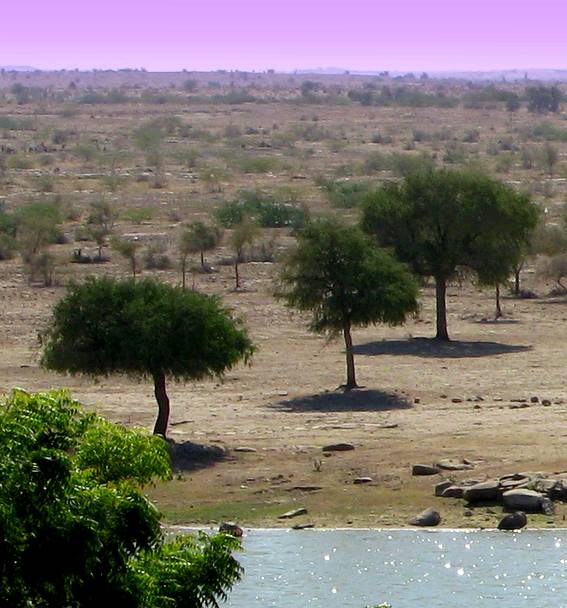 |
| Dry and dusty terrain in Jaisalmer at the fringes of a desert. Some 40 kilometers from here is the Great Thar Desert. |
 |
| A graveyard in Jaisalmer. |
 |
| A sandstone building across Gadisar Lake. |
 |
| A cornet bookstore in one of the narrow alleys of Jaisalmer near my hotel. I bought some postcards here. |
 |
| Another narrow alley at the Jaisalmer Fort, a "working fort", i.e. people live and work here. |
 |
| Jaisalmer Fort rises from the Trikuta Hill. |
 |
| West of Jaisalmer is the desert separating it from Pakistan. |