Showing posts with label Painam-Nagar. Show all posts

Friday, May 20, 2011

Folk Arts and Crafts Museum (Sadarbari) – Picturesque Rural Bangladesh


Upon arrival in Mograpara, a town in Sonargaon (southeast of Dhaka), my guide Mafuz flagged a rickshaw for the three of us – Karin (a Swiss backpacker), Mafuz, and me. It was short of a miracle to get the driver to agree since he would be pedaling for three. We were rowdy, clowning around on our cams, knowing fully well that it looked like a circus act fitting us together in a craggy rickshaw. It was fun!

We crossed Kanchpur Bridge, then plied through a narrow winding road and not long after, we reached this beautiful 2-story colonial, lavishly decorated with stucco floral scrolls outside. It was a combination of pink and white, with a lake rendering the façade a dreamy countenance.


The building itself was built in 1901 as a rajbari, a Raj-style residential palace of a zamindar (landlord). As a consequence of the exodus of the Hindu traders, this rajbari – a Sadarbari – was abandoned, the property left under government administration. While pretty much neglected, in 1975, a famous national painter Shilpacharya Zainul Abedin (known for his Bengal famine paintings), conceptualized a place that would showcase folk arts, traditional craftsmanship, and everything that encompasses cultural heritage. He picked Sonargaon – and commissioned this rajbari from the government.

It is now known as Folk Arts and Crafts Museum - otherwise locally referred to as Lok Shilpa Jadughar .


The whole complex is huge – around 150 bighas (probably 60 acres) characterized by a big lake and 6 ponds, a documentation center, a library, a craft village, 3 bridges, a garden of fruit-bearing and medicinal trees, and of course the 2 museums (the folk arts and crafts and Zainul Abedin Museum).

The disadvantage of having a guide is that you pass through places without knowing much. It’s perfect for lazy tourists but a bit of a downer for people like me. But hey, it was ok to be lazy for a day. There were 2 entrance fees to be paid: 4 taka to enter the grounds, 3 taka for the museum entrance. Rather ridiculously cheap.


Lok Shilpa Jadughar


Upon stepping inside the Folk Arts and Crafts, I started snapping away. Though not beautifully preserved or maintained (some parts were stained and molding, plants growing through ledges), you cannot deny the captivating beauty of its intricate stucco designs. Then Mafuz shyly reminded me, no photography allowed. Oopss! Sorry, but I had a naughty smile on my face. What’s done is done, and we weren’t forewarned. Honestly, I didn’t see signs prohibiting photography. The displays at the museum were divided into 11 galleries: terracotta dolls, pottery, iron products and metal crafts, etc. There were traditional handicrafts, sarees, and depictions of local rural life back in the days. Abedin’s Museum had some of his painting (majority of which were stolen and looted).

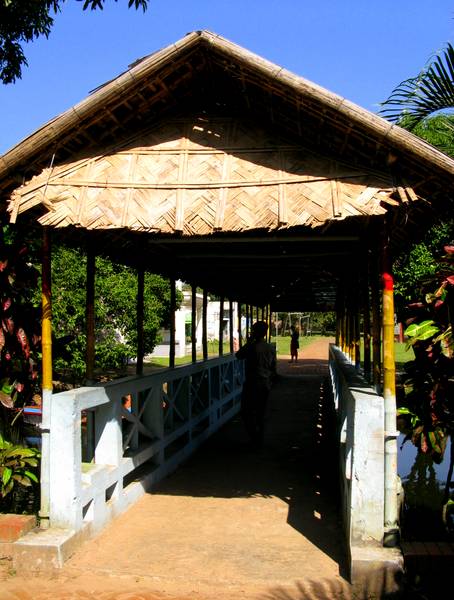
The complex grounds were as picturesque: a lake where you could go boating, wooden bridges crossing ponds, a crafts center selling those beautiful, colorful sarees (although a bit too expensive). It’s easy to find this a favorite, but then, our next itinerary was even more fascinating – a virtual ghost town, the Painam-Nagar.

This is the Eye in the Sky!


This sculpture in Sonargaon's Sadarbari is based on Zainul Abedin's painting, "The Struggle." The acclaimed painter eventually died from lung cancer.


My guide Mafuz and my friend Karin who's a pleasure to watch gliding around in her saree.


Zainul Abedin Museum


Shilpacharya Zainul Abedin


A covered bridge


Tuesday, May 17, 2011

Sonargaon, Bangladesh – Whispers From an Ancient Capital (An Introduction)


There’s always a palpable buzz of excitement when you suddenly realize you’re visiting a part of history. In this case, it is Sonargaon, the ancient – and first capital – of Bangladesh, long before it became a separate country (from India and Pakistan).

ANCIENT CITY

Vikramapura was the cultural and political center of ancient Bengal but everything about it has been passed on through word of mouth. It’s a mythical city that has died in the early inhabitant’s failure to document its existence. There are no documents to show the exact boundary of its territorial unit; no relics; no traces of a very distant past, except for historical hearsay handed down from centuries of Chandra, Sena and Varman rulers that stretch from the 10th century to the 13th century. It is believed though that it existed somewhere in the southeast of Bangladesh.

By the 13th century, a Hindu ruler named Danujamadhava Dasharathadeva felt the need to transfer his dominion to an uncharted region called Suvarnagrama, a name that gradually evolved into its present nomenclature. Sonargaon. The “golden village,” as it was literally translated (or “golden town”). It was a promising place bound by its riches, and its rivers: Meghna River to the east, Shitalakhya River to the west, Daleshwari River to the south, and Brahmaputra River to the north. But like most ruling forces, time wasn't kind and the Hindu ruler gradually lost grip of his power and influence, and with the arrival of the Muslim rulers, he was eventually overwhelmed. Sonargaon was soon annexed to Lakhnauti (under the rule of Shamsuddin Firuz Shah). It became an exigent town as a port and source of “mint”.


In the 2nd quarter of the 14th century, Sonargaon boasted of direct trading connection with China, Java (Indonesia) and Maldives, as noted in the annals of Moroccan adventurer Ibn Batuta. Hou Hien, a Chinese translator, described it as a fortified wall city with tanks, bazaars and a bustling emporium of trade.

With time, it had several change of hands in terms of administration - from the Tughlaq rulers then the arrival of the mughals (Isa Khan, then Musa Khan). With the fall of Musa’s regime (1611), Sonargaon was gradually demoted. Dhaka rose as the capital. And Sonargaon gradually slipped into near obscurity – rotting in its rich but ancient past.

During the early 20th century, Painam-Nagar was developed somewhere in the area of medieval Sonargaon which became a trading center of cotton fabrics. Sonargaon soon again flirted with commercial life. Hindu merchants – “cloth merchants” - built showy colonial houses on a narrow single- road, but a cantankerous, albeit impetuous history has halted the rebirth of Sonargaon. There were (1) the great division between Pakistan and India, (2) the anti-Hindu massacre (the muslim population grew tenfold), and (3) the Indo-Pakistani War (1965).

Most of these affluent Hindu merchants fled to India, and Painam-Nagar virtually turned into a ghost town. These days, the southern town of Mograpara is starting to stir into life. This is where most tourists arrive from Dhaka. From here, a rickshaw can be hired to visit sites.


Though most of the ancient Sonargaon (10th to 13th century) have disappeared like Vikramapura, a few reminders of the succeeding epoch have remained: the Goaldi Mosque, a pre-Mughal bridge, a single rajbari (a Raj-era palace built by a landlord called “zamindar” converted into the Folk Arts Museum), a mausoleum, and some minor mosques.

Located 27 kilometers (some say 29, LP says its 23) southeast of Dhaka, Sonargaon magically transports you into the past – into this long forgotten and neglected land that has “dwindled into a village with dense jungle”. If you want local color, and grassroot Bangladesh, this is probably one of the best places to visit.

The bus ride from Dhaka will take 40 minutes to 1 hour, on a measly 15-taka ($0.20 or PhP8.80) bus ride. Be sure to tell the bus conductor that your destination is Mograpara, otherwise, your “Sonargaon” (pronounced “sho-nar-gahn”) will take you to Pan Pacific Sonargaon, says LP. I had great company - my guide Mafuz and a sweet Swiss girl I kept calling Helen, until she corrected me at our last itinerary. “It’s Karin,” she bashfully smiled. She is a doctor too. Ain’t that nice?

This is the Eye in the Sky who feels the need to do a little introductory piece.


Next up: the actual visit in Sonargaon.


Rajbari Palace turned into a museum.


Dessert? No, they're supposedly a daily staple eaten like rice - and despite its delectable look, it doesn't have a taste. (They say it does.)


Tombs, Sonargaon has a lot of.


"It's Karin," says she. My friend from Bern has traveled far and wide and even scaled mountains.


Intricate designs found at the Goaldi Mosque which has a pre-Mughal design (built 1519).