Showing posts with label Mograpara. Show all posts

Monday, June 13, 2011

Faith, Colors and Cheap Bus Rides in Sonargaon


The mirthful gift of chance plays a part in discovering and capturing moments that arrest an exigent sequence of a split-second itinerary. We were scurrying along compressed alleyways when - oops, wait - I found myself peeping through a grilled window and found this sobering sight of someone in deep communion with his God (see above). It's moments like this that makes me pause and cogitate on how fast I've been riding through life. We sometimes need to slow down and meditate on our journey so far. This renders every fleeting moment special. Suddenly, the anonymous corridors and forgettable alleyways I step on acquire meaning. Isn't that a better existence... to be made aware that I am not exactly wasting my waking hours navigating some remote place in the world?


On a separate note, we found this sari merchant (above) displaying his colorful products at the Sadarbari shop on the grounds of the Folk Arts and Crafts Museum. If they were candies, I'd have gone into a state of hyperglycemia. I had to feign disinterest simply because doing otherwise would encourage them to shove these luminescent products down my throat. Exquisite as they are, saris are almost never used in my country (except by Indian expats) the way they're not exigent properties in middle class America. Moreover, buying one would gravely place a dent on a tight budget. Isn't that a more valid concern than disinterest?


Potato economy. We passed by a "market" - well, it was a short line of makeshift stalls selling market produce, a great number of them were potatoes. There were aubergines (eggplants) and peppers too.


At around 1:45 PM, while navigating Sonargaon, we dropped by another small shop selling tea and these bread-based muffin. I didn't think it would qualify as lunch, but I didn't wanna complain.


Our ride back, from Mograpara to Dhaka (Gulistan Bus Station), was on this craggy non-AC bus. The locals were very accommodating, giving us their seats. For a measly 15 taka ($0.20 or PhP8.90), this is an interesting way to experience a slice of Bangladesh and its endearing populace. It takes 45 minutes to 1 hour to travel from Dhaka to Sonargaon (Mograpara).


Journeys in far off places aren't always easy, and it is when you're back home with your baggage half unpacked that you realize the big strides you've taken to become a part of these distant little worlds. I am forever grateful to the wisdom of other adventure seekers for encapsulating "journeys". Jean Luc Picard (the fictitious Starfleet commander) once said, "Time is a companion that goes with us on a journey. It reminds us to cherish each moment, because it will never come again. What we leave behind is not as important as how we have lived."

Every one has to take his first step to venture into the world. This is never easy. Navigating outside your comfort zone. Dan Rather (former CBS news anchor) once noted that "If all difficulties were known at the outset of a long journey, most of us would never start out at all." But I am a living witness. These difficulties carry their Mastercard moments.

Priceless.

This is the Eye in the Sky.


Friday, May 20, 2011

Folk Arts and Crafts Museum (Sadarbari) – Picturesque Rural Bangladesh


Upon arrival in Mograpara, a town in Sonargaon (southeast of Dhaka), my guide Mafuz flagged a rickshaw for the three of us – Karin (a Swiss backpacker), Mafuz, and me. It was short of a miracle to get the driver to agree since he would be pedaling for three. We were rowdy, clowning around on our cams, knowing fully well that it looked like a circus act fitting us together in a craggy rickshaw. It was fun!

We crossed Kanchpur Bridge, then plied through a narrow winding road and not long after, we reached this beautiful 2-story colonial, lavishly decorated with stucco floral scrolls outside. It was a combination of pink and white, with a lake rendering the façade a dreamy countenance.


The building itself was built in 1901 as a rajbari, a Raj-style residential palace of a zamindar (landlord). As a consequence of the exodus of the Hindu traders, this rajbari – a Sadarbari – was abandoned, the property left under government administration. While pretty much neglected, in 1975, a famous national painter Shilpacharya Zainul Abedin (known for his Bengal famine paintings), conceptualized a place that would showcase folk arts, traditional craftsmanship, and everything that encompasses cultural heritage. He picked Sonargaon – and commissioned this rajbari from the government.

It is now known as Folk Arts and Crafts Museum - otherwise locally referred to as Lok Shilpa Jadughar .


The whole complex is huge – around 150 bighas (probably 60 acres) characterized by a big lake and 6 ponds, a documentation center, a library, a craft village, 3 bridges, a garden of fruit-bearing and medicinal trees, and of course the 2 museums (the folk arts and crafts and Zainul Abedin Museum).

The disadvantage of having a guide is that you pass through places without knowing much. It’s perfect for lazy tourists but a bit of a downer for people like me. But hey, it was ok to be lazy for a day. There were 2 entrance fees to be paid: 4 taka to enter the grounds, 3 taka for the museum entrance. Rather ridiculously cheap.


Lok Shilpa Jadughar


Upon stepping inside the Folk Arts and Crafts, I started snapping away. Though not beautifully preserved or maintained (some parts were stained and molding, plants growing through ledges), you cannot deny the captivating beauty of its intricate stucco designs. Then Mafuz shyly reminded me, no photography allowed. Oopss! Sorry, but I had a naughty smile on my face. What’s done is done, and we weren’t forewarned. Honestly, I didn’t see signs prohibiting photography. The displays at the museum were divided into 11 galleries: terracotta dolls, pottery, iron products and metal crafts, etc. There were traditional handicrafts, sarees, and depictions of local rural life back in the days. Abedin’s Museum had some of his painting (majority of which were stolen and looted).

The complex grounds were as picturesque: a lake where you could go boating, wooden bridges crossing ponds, a crafts center selling those beautiful, colorful sarees (although a bit too expensive). It’s easy to find this a favorite, but then, our next itinerary was even more fascinating – a virtual ghost town, the Painam-Nagar.

This is the Eye in the Sky!


This sculpture in Sonargaon's Sadarbari is based on Zainul Abedin's painting, "The Struggle." The acclaimed painter eventually died from lung cancer.


My guide Mafuz and my friend Karin who's a pleasure to watch gliding around in her saree.


Zainul Abedin Museum


Shilpacharya Zainul Abedin


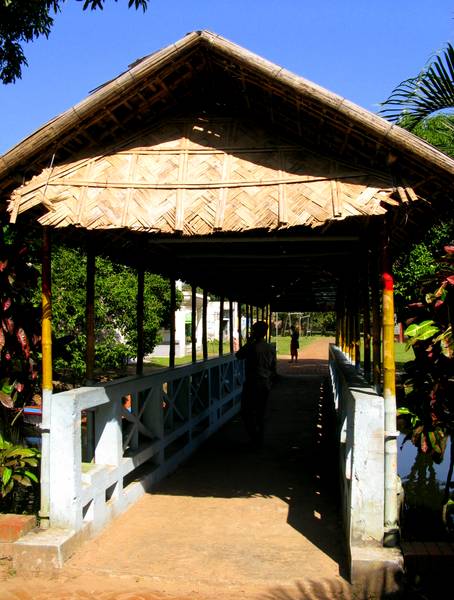
A covered bridge


Tuesday, May 17, 2011

Sonargaon, Bangladesh – Whispers From an Ancient Capital (An Introduction)


There’s always a palpable buzz of excitement when you suddenly realize you’re visiting a part of history. In this case, it is Sonargaon, the ancient – and first capital – of Bangladesh, long before it became a separate country (from India and Pakistan).

ANCIENT CITY

Vikramapura was the cultural and political center of ancient Bengal but everything about it has been passed on through word of mouth. It’s a mythical city that has died in the early inhabitant’s failure to document its existence. There are no documents to show the exact boundary of its territorial unit; no relics; no traces of a very distant past, except for historical hearsay handed down from centuries of Chandra, Sena and Varman rulers that stretch from the 10th century to the 13th century. It is believed though that it existed somewhere in the southeast of Bangladesh.

By the 13th century, a Hindu ruler named Danujamadhava Dasharathadeva felt the need to transfer his dominion to an uncharted region called Suvarnagrama, a name that gradually evolved into its present nomenclature. Sonargaon. The “golden village,” as it was literally translated (or “golden town”). It was a promising place bound by its riches, and its rivers: Meghna River to the east, Shitalakhya River to the west, Daleshwari River to the south, and Brahmaputra River to the north. But like most ruling forces, time wasn't kind and the Hindu ruler gradually lost grip of his power and influence, and with the arrival of the Muslim rulers, he was eventually overwhelmed. Sonargaon was soon annexed to Lakhnauti (under the rule of Shamsuddin Firuz Shah). It became an exigent town as a port and source of “mint”.


In the 2nd quarter of the 14th century, Sonargaon boasted of direct trading connection with China, Java (Indonesia) and Maldives, as noted in the annals of Moroccan adventurer Ibn Batuta. Hou Hien, a Chinese translator, described it as a fortified wall city with tanks, bazaars and a bustling emporium of trade.

With time, it had several change of hands in terms of administration - from the Tughlaq rulers then the arrival of the mughals (Isa Khan, then Musa Khan). With the fall of Musa’s regime (1611), Sonargaon was gradually demoted. Dhaka rose as the capital. And Sonargaon gradually slipped into near obscurity – rotting in its rich but ancient past.

During the early 20th century, Painam-Nagar was developed somewhere in the area of medieval Sonargaon which became a trading center of cotton fabrics. Sonargaon soon again flirted with commercial life. Hindu merchants – “cloth merchants” - built showy colonial houses on a narrow single- road, but a cantankerous, albeit impetuous history has halted the rebirth of Sonargaon. There were (1) the great division between Pakistan and India, (2) the anti-Hindu massacre (the muslim population grew tenfold), and (3) the Indo-Pakistani War (1965).

Most of these affluent Hindu merchants fled to India, and Painam-Nagar virtually turned into a ghost town. These days, the southern town of Mograpara is starting to stir into life. This is where most tourists arrive from Dhaka. From here, a rickshaw can be hired to visit sites.


Though most of the ancient Sonargaon (10th to 13th century) have disappeared like Vikramapura, a few reminders of the succeeding epoch have remained: the Goaldi Mosque, a pre-Mughal bridge, a single rajbari (a Raj-era palace built by a landlord called “zamindar” converted into the Folk Arts Museum), a mausoleum, and some minor mosques.

Located 27 kilometers (some say 29, LP says its 23) southeast of Dhaka, Sonargaon magically transports you into the past – into this long forgotten and neglected land that has “dwindled into a village with dense jungle”. If you want local color, and grassroot Bangladesh, this is probably one of the best places to visit.

The bus ride from Dhaka will take 40 minutes to 1 hour, on a measly 15-taka ($0.20 or PhP8.80) bus ride. Be sure to tell the bus conductor that your destination is Mograpara, otherwise, your “Sonargaon” (pronounced “sho-nar-gahn”) will take you to Pan Pacific Sonargaon, says LP. I had great company - my guide Mafuz and a sweet Swiss girl I kept calling Helen, until she corrected me at our last itinerary. “It’s Karin,” she bashfully smiled. She is a doctor too. Ain’t that nice?

This is the Eye in the Sky who feels the need to do a little introductory piece.


Next up: the actual visit in Sonargaon.


Rajbari Palace turned into a museum.


Dessert? No, they're supposedly a daily staple eaten like rice - and despite its delectable look, it doesn't have a taste. (They say it does.)


Tombs, Sonargaon has a lot of.


"It's Karin," says she. My friend from Bern has traveled far and wide and even scaled mountains.


Intricate designs found at the Goaldi Mosque which has a pre-Mughal design (built 1519).


Thursday, September 9, 2010

Bangladesh Fortuitous Jolt of Surprise – A New Introduction


Bangladesh has always fascinated me. Didn’t Rabindranath Tagore come from this country? Considered by United Nations as one of the world’s 50 poorest nations, Bangladesh populates itself like there's no tomorrow. It has a population of 162,221,000 spread across 147,570 square kilometers of mostly agricultural land. The Philippines has an area more than double Bangladesh –299,764 square km and a population of 92 million. Now compare this to the state of Texas which has an area of 696,241 square km, more than 4x that of Bangladesh, but a population of just 24,700,000.

The country’s population increases by 2 million a year, and is expected to reach 185 million in 10 years (2020). A country this size may hardly be sustainable in a decade’s time if this isn’t regulated. Sure, the precepts of the largely myopic Roman Catholic doctrines may dismiss any forms of contraception, but thank heavens Bangladeshis are mostly muslims, with a government hang up on political grandstanding. This topic on density is something I strongly believe I should emphasize in this post.

Until the early 70’s, Bangladesh was a part of Pakistan, East Pakistan to be exact. This was a result of Islamic solidarity - when political and religious divisiveness segregated people into India's Hindu populace and the muslims who had to move to either West Pakistan or East Pakistan. But decades of neglect, as well as declaring “urdu” as the sole national language were a direct affront to the Bangladeshis who don't speak urdu. This triggered a Bangla Language Movement, since you really can't ignore a people's dialect. This was eventually followed by successful secessionist movements. On March 26, 1971, Bangladesh (which means "land of the Bangla speakers") was a free nation.


Map of Bangladesh. This photo only courtesy of www.nationsonline.org.


The Pink Palace or Ahsan Manzil is a majestic and cheap visit. I paid only 2 takas for the entrance.

Dhaka, the capital, sits on the bank of the Buriganga River. It is one of the most densely populated cities in the world and forms the world's 9th largest agglomeration. It is home to about 600,000 rickshaws plying the metropolis everyday. In one part, these facts frighten me; In another, they challenge the crazy spirit in me. But as long as I envision myself actually coming out unscathed from a visit, I am there. Bangladesh is one of these bewildering countries. And this September, we shall pay homage to a country that has endured decades of separatism and sovereign struggle.

Bangladesh doesn’t have a lot of foreign tourists, and if you find yourself standing on a street in Dhaka, you will become circus attraction. Suddenly, you’re the most unique being in their universe. Do they steal glances at you? Heck, no! They will gather around you, blatantly stare at you, and they will be unapologetically shameless to satiate their curiosity! Occasionally, someone will come over and send the throng away, just so he can take over the staring business. This can get hilarious at times. I remember crossing a street where people to my right – and to my left were attentive of my presence, instead of the chaos on the streets. During such street-crossing, I was asked 5x by 5 different people. Which country you from? Are you student? Are you married? Do you like Bangladesh? Yes, I like Bangladesh, except all the staring! Haha! In fact, I have blogged how they have turned staring into an art form.

In Dhaka, you can experience how Hollywood superstars feel, and enjoy the attention, until they start asking obtrusive questions. You think I am exaggerating? Think again! If you’re looking for peace and quite, boy, you are in the wrong place! But if you’re free spirited and don’t mind the inquisitive world around you, then you can relish on the extreme curiosity of the Bangladeshi people. There are very few international tourists in Bangladesh, thus the ones who make it there are met with brimming curiosity.

Despite stark poverty, overpopulation, and an inefficiently delivered public service, Banglas remain one of the most hospitable people we’ve ever encountered.


Bangladesh and Philippines Eye to Eye

Bangladeshis have interesting parallelisms from the Philippines. They love to opinionate on matters of national and international concern. A big chunk of the population finds migration to the United States as one step to heaven, and getting a U.S. visa is viewed like winning the lottery. Bangladeshis also value their freedom of expression so much that it has grown into a tired excuse of redress in forms of hartals (strikes) and demonstrations. At some point in time, they have actually halted economic growth. Too much freedom can sometimes halt progress. Journalists are also attacked and assassinated much like in the Philippines. In Transparency Organization’s ranking of the world’s corruption index, the Philippines and Bangladesh – along with Belarus and Pakistan, rank 139th in a list of 180 countries (number 1 – New Zealand - being the least corrupt, and number 180 – Somalia – as the most corrupt). Finally, this is a country frequently ravaged by storms and cyclones. Sounds familiar?


Curzon Hall of Dhaka University, the elegant European-Mughal style architecture is eye-catching, erected in 1905.


VISA APPLICATION

I’ve always hated visa applications, but since I wanted to visit Bangladesh, I had to submit a slew of paper work. Upon realizing the volume of these requirements, I actually thought I was migrating instead of visiting. When I submitted my documents at the Bangladesh Embassy (Universal Re-Building, 2nd Floor, Paseo de Roxas, corner Perea Street in Legaspi Village, Makati City -+63-2-817-5001, +63-2-817-5010 and call before going there), the girl (a Filipina) assigned for the documents asked what my purpose was in visiting Bangladesh. I said, “As a tourist.” Then she replied with a sarcastic, “Owww? Di nga!” I had to force my brow against unwarranted elevation, then told her what my profession was. These are moments that place you on a defensive stance, and telling her my educational attainment was a faster way to shut her up. How was I to know that the people at the Bangladesh Embassy could hardly believe there was actually someone stupid enough to visit their country? Was that it? And why would anyone illegally migrate to South Asia’s poorest region - to sew jeans for export to India? I don’t sew garments, honey. I suture eyes! Later that day, the same lady offered a conciliatory gift: a 90-page color book called “Bangladesh Basic Facts”, published by the External Publicity Wing of Bangladesh’s Ministry of Foreign Affairs, which I must have read half a dozen times. Nice.

I only planned on a few days in Bangladesh, to be honest about it. It was just a protracted transit en route to India via Kolkata. I planned on crossing the border overland. I applied for 3 days, and I was given 7 by the Bangladeshi Embassy in Manila. Upon arrival in Dhaka (from KL), the immigration officer read my immigration card – this one will ask about your profession and educational attainment (a question that is commonly asked even by the locals) – then stamped 30 days! Most other foreigners – Caucasians, especially – get 15 days, unless their visa specifies 3 months! This was a more generous people, not the 7 days that the local embassy gave me. I was initially weary that such attitude from the idiotic embassy staff would actually extend to the immigration counter once I was in Dhaka. But I was so wrong!

One wonders why embassy people are so uptight. It’s easy to be strict without being rude or a pompous ass. I remembered how business-like the staff at the French Embassy was, but my Schengen was a generous number of weeks. Same story with the Danish Embassy who gave me 1 week more than what I requested. And these are very rich countries, aren’t they? Then we have something like the Bangladesh Embassy who treats tourists as though we are out to pilfer their precious land? Check the country’s history and you’d wonder if there’s anything left for anyone to pilfer.


Baitull Mukarram National Mosque in Central Dhaka

Anyway, after a very welcoming arrival (late in the evening), I carried my stamped out passport to the immigration hall of Zia International Airport. People were queuing towards custom inspection (they had an xray machine, but for some reason, they were manually opening the suitcases) prior to the main exit door. When they saw me, the only Asian in a sea of Indians, Bangladeshis and 2 Caucasians, they just nodded at me, and signaled that I could take my bag out without further inspection. And I felt like royalty! With someone from my hotel picking me up, it was a relief to be welcomed late in the evening by friendly faces. This was turning out to be more pleasant than I expected.

This is the Eye in the Sky!


Tara Masjid - or Star Mosque - considered by Lonely Planet as Dhaka's most popular tourist attraction. This has a striking decoration of colored glass set in white tiles - and a very accommodating mullah who "rolled the carpet" for me. I was just so honored. They thought I was Japanese. The sitara's recent renovation is funded by Japanese money, in fact there's a tile there somewhere showing Mount Fuji.


5 taka rickshaws at the Sadarghat area.


Fast Facts

Official Language: Bengali or Bangla

Currency: taka

Exchange rate: $1=69.65 (BDT) takas, PhP1=1.57 takas, 1 Indian rupee=1.50 takas, 1 baht=2.25 takas, 1 ringgit=22.39 takas, 1 euro=88.69 takas, 1 british pound=108 takas

Primary economy – Agrarian, it is the largest producer of Jute

Staple food: rice

Non-religious anniversaries: Bengali New Year’s Day or Pahela Baishakh on April 14, Language Martyr’s Day on February 21, Independence Day on March 26, National Revolution and Solidarity Day on November 7

Religion: Islam (88.3%), Hinduism (10.5%), Buddhism, Christian, Animists

Time difference from Malaysia and Philippines: 2 hours

Bangladeshi cars drive on the left.

Visas have to be secured from your country of origin. There are no visas on arrival. Visa extensions are possible once in Dhaka, but processing will take a minimum of 3 days, sometimes 2 if you’re lucky.


Shipyards at the Buriganga River as I was cruising. An hour's boat ride will cost you 90 takas.


At the beautiful Goaldi Mosque in the ancient city of Sonargaon with my friend Karin. She's a Swiss traveler whose day job is that of a surgeon in Bern. This shot was taken by Mahfuz, my guide. In a moment of sheer embarrassment, I realized that I had been calling her the wrong name - Helen- which she never corrected until later in the day. This was that moment.


Squatters at Painam Nagar. I was a bit embarrassed walking inside the houses, like I had all the right to do so, but the people who occupied the otherwise empty crumbling buildings were good natured enough to greet us with a smile. We will post our photos from that visit soon.


Mausoleum of National Leaders - 3 heroes rest here. They fought for the Bangla langauge and independence. Just at the southwest corner of Suhrawady Uddyan (garden).


100 year old houses in Sonargaon in state of decay.


Mograpara, Sonargaon. My guide Mahfuz made sure I could see the important sights during my short visit. He dealt with rickshaw and taxi wallahs, then I had to join his family home for cha and to see his mother who has hypertension, diabetes and cataract.


Potato economy at the bowels of Old Dhaka


Istara Masjid and the faithful


Bangladeshis are news-hungry. They will read about issues that concern local governance as well as U.S. headlines. Mornings in Dhaka will find you in streets lined with stacks over stacks of newspapers.


Sonargaon's crumbling buildings at the Painam Nagar district, remains of a tiny settlement on a narrow street, consisting of 50 dilapidated mansions built by Hindu merchants, who have since migrated to India to escape Hindu persecution during the war. Some people refer to it as a ghost city - buildings with no owners. It was eerie walking through the street. The deserted buildings later turned out to be occupied by squatters who live in derelict conditions: no electricity, no toilets, no water supply except for the river running beside these buildings.


Horse-drawn carriage at the back of the imposing Parliament Building, located at Sher-e Bangla Nagar area.


Auto-rickshaw: meter plus 20 takas. It is close to impossible for drivers to use their meters.


Next: Arriving at the Hazrat Shahjalal International Airport and Hotel Pacific: http://eye-in-the-blue-sky.blogspot.com/2010/09/dhaka-bound-anxious-plus-hazrat.html


Bangladeshi taka: They are beautifully and colorfully drawn, they sometimes looked like play money.