Showing posts with label Folk Arts and Crafts Museum. Show all posts

Monday, June 13, 2011

Faith, Colors and Cheap Bus Rides in Sonargaon


The mirthful gift of chance plays a part in discovering and capturing moments that arrest an exigent sequence of a split-second itinerary. We were scurrying along compressed alleyways when - oops, wait - I found myself peeping through a grilled window and found this sobering sight of someone in deep communion with his God (see above). It's moments like this that makes me pause and cogitate on how fast I've been riding through life. We sometimes need to slow down and meditate on our journey so far. This renders every fleeting moment special. Suddenly, the anonymous corridors and forgettable alleyways I step on acquire meaning. Isn't that a better existence... to be made aware that I am not exactly wasting my waking hours navigating some remote place in the world?


On a separate note, we found this sari merchant (above) displaying his colorful products at the Sadarbari shop on the grounds of the Folk Arts and Crafts Museum. If they were candies, I'd have gone into a state of hyperglycemia. I had to feign disinterest simply because doing otherwise would encourage them to shove these luminescent products down my throat. Exquisite as they are, saris are almost never used in my country (except by Indian expats) the way they're not exigent properties in middle class America. Moreover, buying one would gravely place a dent on a tight budget. Isn't that a more valid concern than disinterest?


Potato economy. We passed by a "market" - well, it was a short line of makeshift stalls selling market produce, a great number of them were potatoes. There were aubergines (eggplants) and peppers too.


At around 1:45 PM, while navigating Sonargaon, we dropped by another small shop selling tea and these bread-based muffin. I didn't think it would qualify as lunch, but I didn't wanna complain.


Our ride back, from Mograpara to Dhaka (Gulistan Bus Station), was on this craggy non-AC bus. The locals were very accommodating, giving us their seats. For a measly 15 taka ($0.20 or PhP8.90), this is an interesting way to experience a slice of Bangladesh and its endearing populace. It takes 45 minutes to 1 hour to travel from Dhaka to Sonargaon (Mograpara).


Journeys in far off places aren't always easy, and it is when you're back home with your baggage half unpacked that you realize the big strides you've taken to become a part of these distant little worlds. I am forever grateful to the wisdom of other adventure seekers for encapsulating "journeys". Jean Luc Picard (the fictitious Starfleet commander) once said, "Time is a companion that goes with us on a journey. It reminds us to cherish each moment, because it will never come again. What we leave behind is not as important as how we have lived."

Every one has to take his first step to venture into the world. This is never easy. Navigating outside your comfort zone. Dan Rather (former CBS news anchor) once noted that "If all difficulties were known at the outset of a long journey, most of us would never start out at all." But I am a living witness. These difficulties carry their Mastercard moments.

Priceless.

This is the Eye in the Sky.


Friday, May 20, 2011

Folk Arts and Crafts Museum (Sadarbari) – Picturesque Rural Bangladesh


Upon arrival in Mograpara, a town in Sonargaon (southeast of Dhaka), my guide Mafuz flagged a rickshaw for the three of us – Karin (a Swiss backpacker), Mafuz, and me. It was short of a miracle to get the driver to agree since he would be pedaling for three. We were rowdy, clowning around on our cams, knowing fully well that it looked like a circus act fitting us together in a craggy rickshaw. It was fun!

We crossed Kanchpur Bridge, then plied through a narrow winding road and not long after, we reached this beautiful 2-story colonial, lavishly decorated with stucco floral scrolls outside. It was a combination of pink and white, with a lake rendering the façade a dreamy countenance.


The building itself was built in 1901 as a rajbari, a Raj-style residential palace of a zamindar (landlord). As a consequence of the exodus of the Hindu traders, this rajbari – a Sadarbari – was abandoned, the property left under government administration. While pretty much neglected, in 1975, a famous national painter Shilpacharya Zainul Abedin (known for his Bengal famine paintings), conceptualized a place that would showcase folk arts, traditional craftsmanship, and everything that encompasses cultural heritage. He picked Sonargaon – and commissioned this rajbari from the government.

It is now known as Folk Arts and Crafts Museum - otherwise locally referred to as Lok Shilpa Jadughar .


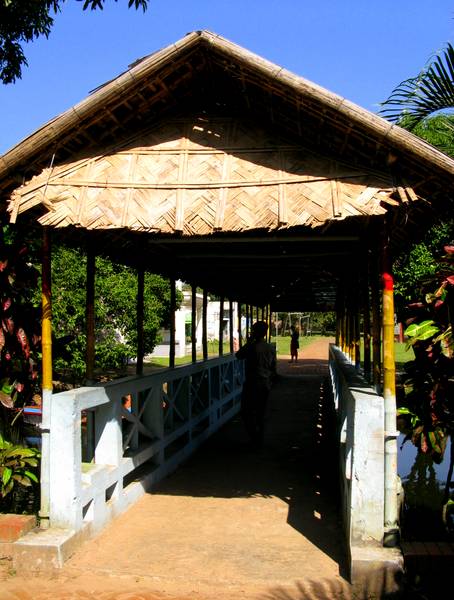
The whole complex is huge – around 150 bighas (probably 60 acres) characterized by a big lake and 6 ponds, a documentation center, a library, a craft village, 3 bridges, a garden of fruit-bearing and medicinal trees, and of course the 2 museums (the folk arts and crafts and Zainul Abedin Museum).

The disadvantage of having a guide is that you pass through places without knowing much. It’s perfect for lazy tourists but a bit of a downer for people like me. But hey, it was ok to be lazy for a day. There were 2 entrance fees to be paid: 4 taka to enter the grounds, 3 taka for the museum entrance. Rather ridiculously cheap.


Lok Shilpa Jadughar


Upon stepping inside the Folk Arts and Crafts, I started snapping away. Though not beautifully preserved or maintained (some parts were stained and molding, plants growing through ledges), you cannot deny the captivating beauty of its intricate stucco designs. Then Mafuz shyly reminded me, no photography allowed. Oopss! Sorry, but I had a naughty smile on my face. What’s done is done, and we weren’t forewarned. Honestly, I didn’t see signs prohibiting photography. The displays at the museum were divided into 11 galleries: terracotta dolls, pottery, iron products and metal crafts, etc. There were traditional handicrafts, sarees, and depictions of local rural life back in the days. Abedin’s Museum had some of his painting (majority of which were stolen and looted).

The complex grounds were as picturesque: a lake where you could go boating, wooden bridges crossing ponds, a crafts center selling those beautiful, colorful sarees (although a bit too expensive). It’s easy to find this a favorite, but then, our next itinerary was even more fascinating – a virtual ghost town, the Painam-Nagar.

This is the Eye in the Sky!


This sculpture in Sonargaon's Sadarbari is based on Zainul Abedin's painting, "The Struggle." The acclaimed painter eventually died from lung cancer.


My guide Mafuz and my friend Karin who's a pleasure to watch gliding around in her saree.


Zainul Abedin Museum


Shilpacharya Zainul Abedin


A covered bridge