Showing posts with label india. Show all posts

Saturday, September 6, 2014

Desert Abode in Khouri (Great Thar Desert, India)


Wouldn't you be enraptured with geometrically distinct abodes (above) made out of sandstones, right at the fringes of a desert?

I was fascinated no end. After a safari at the Great Thar Desert in north India, my camel owner took me to Khouri, a remote village in the desert. "Khouri" - that's how the sign post was written. But when I tried to look for any information about it, there's none to be found in the world wide web. Nada.

When I say "village", it would be in the context of a household operating within a community. But there weren't any other houses in the vicinity. It was like tapping a heel and you find a yellow brick road leading somewhere. Isn't that a joy?

This is the Eye in the Khouri Sky!


Tuesday, July 29, 2014

The Cave of Sittanavasal Hill - Monks' Retreat at the Fringes of Pudokottai, Tamil Nadu (India)


Somewhere in nowhereland called Trichy in South India, I decided to head deeper into the desolate plains 38 kilometers by bus to Pudokottai. Pushing the so-called envelope, I hopped into another bus and traveled 20 kilometers further. I was forewarned by my readings never to head into Sittanavassal alone. There were anecdotes of muggings on solitary visitors and these fleetingly gave me goosebumps. However, goosebumps never stopped me before. That late afternoon, I found one of the last buses bound for Sittanavasal for the day, albeit my last chance to discover for myself a road less taken in that area.

I wasn't going to town. But to an outlying cave turned into a temple.

It was late. The sun had graduallly slid in the horizon; its existing light providing a hypnagogic overlay in the surroundings. I asked the driver's assistant to inform me when I am in the area already. Then I hopped out of the bus and found myself morbidly alone on a steppe with nothing but shrubs, rice paddies, a pond littered with lotuses, and from a distance a hill with a cave - the Cave of Sittanavasal Hill.

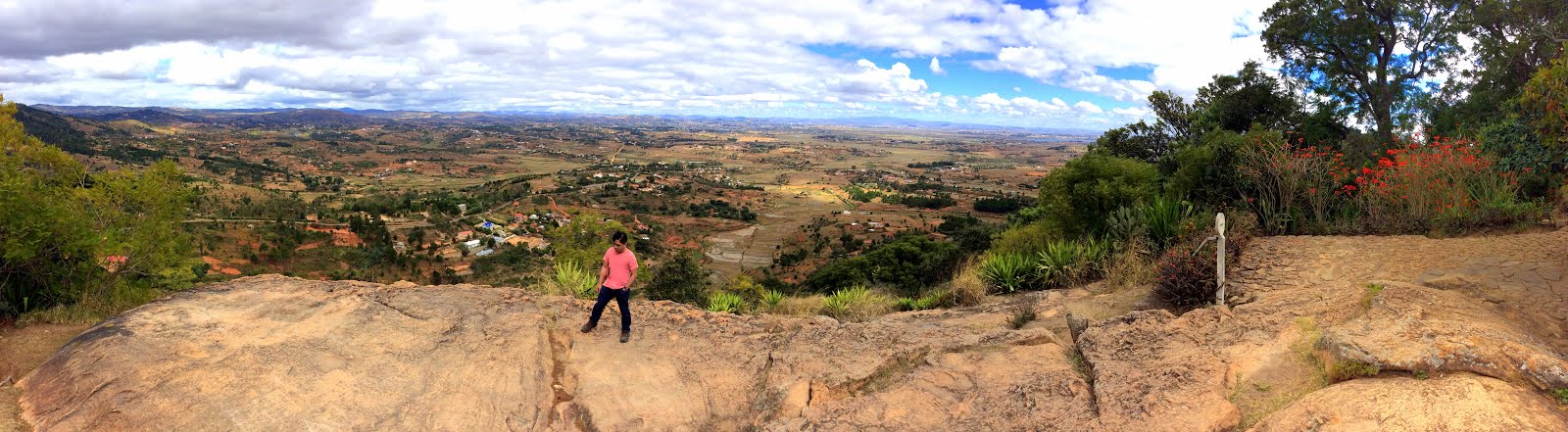
I walked up the hill to find a cave where meditating monks take shelter. There was no elaborate temple to speak of. The famous Sittanavasal Jain Temple is located elsewhere at the town proper further north. This was just an empty cave on a considerable elevation, with a breath-taking view of the green valley below.

En route to the cliff, I heard voices. I realized I was not alone. I had mixed feeling about this, anxious even. They could be the heel and anti-heroes I was duly warned about - and I could be in trouble! Or they could be hospitable locals. I crossed my fingers. And guess what: six Tamil students were on their way to visit the cave temple. I gainfully acquired 6 new friends and protectors who acted as though I was a guest in their own abode. In principle, I was. More than anything, I was thanking the heavens to be in their kind company in the midst of the distant heath.


"Sittanavasal", the conspicuously tongue-twisting term, is a word play of a Tamil word that meant "abode of great saints". Sittanavasal Cave - aka "Arivar Kovil" - has a long and rich history behind it. Try 7th century, when it had been ascribed as a Jain Temple; a marbly rock west of the stony mound, excavated in a bluff. The monks (with nothing but their robes) would sit, cogitate and sleep on the slippery floor of the cave - to meditate, pray for enlightenment and attain nirvana. Unfortunately for me, the cave was deserted at the time of visit. I couldn't get near the interiors said to be inundated with fresco-secco art. There were protective bars probably meant to discourage prospective vandals.

The hike up the hill wasn't a walk in the park. In no time, I was drenched in my own perspiration. In contrast, my new found friends didn't even break into a sweat. How embarrassing!

There were minor concavities and colorful altars of elephants, horses and goats nearby. The sprawl of the fields yielded not a single dwelling. The place felt like a "wild south" if there ever was one in India. By the time we got back to the deserted highway to wait for our bus, the last few gasps of sunlight have but dissipated into the darkness.

I rode back in introspective silence towards Pudokottai to catch my night bus back to Trichy. There was something immensely satisfying with what just transpired. As an added bonus, the guys - who were still practically strangers - decided to pay for my bus fare. For all intents and purposes, I am far from being a pauper, but financial capacity hardly plays into the hospitality of people or their generous culture. How's that for an all-inclusive adventure? How lucky could I get?

This is the Eye in the Sky!

View from the rocky cliff - the western plain of Sittanavasal Hill.

Well polished stone beds or Ezhadippattam (aka Jaina beds) used by Jaina ascetics. There are Tamil Brahmi inscriptions (as well as vandalisms) written on these rock beds. On one of these beds, sallekhana - "fasting unto death" - has been performed. Ouch.
My protectors, guide and friends from Pudokottai.


The climb up this slippery, uneven hill to get to the westward cave.

Friday, June 27, 2014

In a Quiet Town Called Thiruvaiyaru, Tamil Nadu


Quiet town. Way beyond the consciousness of the restless traveling souls.

This is Thiruvaiyaru. On a whim, I decided to head further into the backroads of Thanjavur, heading deeper into the bowels of South India. The whole trip had me riding one of those craggy, dilapidated non-AC buses that I so ironically enjoy. So I walked within the confluence of narrow alleys. After almost being shredded to pieces by an unwelcoming stray dog, I finally found the unseemly temple, the site of a religious pilgrimage. But what I liked more was communing with the Cavery River.

"Hello, Mr. Cavery. Pleased to meet you." From its placid flow, I must have imagined a bump on the waters, like a gentle splash, as though it had acknowledged my presence. I smiled.

Meanwhile, the temple wasn't much of a sight but I knew of its sentimental, albeit religious significance to the locals.

Thiruvaiyaru is located 13 kilometers from Thanjavur in the Indian state of Tamil Nadu.

This is the Eye in the Sky!

Wednesday, February 26, 2014

Bromance in Bangalore


I was in Bangalore walking along the stately Cubbon Park when I saw these two gentlemen. Though I honestly didn't mean to pry, they were walking where I was headed. Before long, I saw their fingers lock as they walk hand in hand, seemingly lost in their own world. Sweet. :)

Eye in the Sky indeed.

Saturday, March 30, 2013

Chennai International Airport - India's Third Busiest


Chennai International. This photo only courtesy of syska.com.
Chennai International Airport services both international (Annadurai Airport Terminal) and domestic flights (Kamaraj Airport terminal). Its two terminals have been named after former chief ministers of the state of Tamil Nadu.

It's located at the fringes of the metropolis, along GST Road in the neighborhood of Tirusalam (Kanchipuram district). I've been to both terminals, but to be honest, I am a bit disoriented as to the location of both terminals because most of my transits there were hurried. In this post, we feature a few photos from out fast transit.

What's interesting is the new 5-story domestic airport: it's swanky, and can accommodate 1,000 more (every 3 hour turnover) passengers than the old terminal. The old domestic accommodates 2,300 passengers. On cursory glance, the new one employs generous space compared to the tightly squeezed check-in counters of the old. The international terminal of Annadurai, on the other hand, is more than serviceable. Check-in and check-out proceedings are fast. They have to. After all, it's being used by 13 million annual passengers and about 350 air crafts daily.

Historically, Asia's first ever flight was flown from Chennai in 1910 - a feat performed by Corsican hotelier Giacomo D'Angelis with his biplane. Eons later, Chennai has India's third busiest airport.

This is the Eye in the Sky!


Check-in counters of the domestic terminal.


International Terminal's front lobby.

Annadurai's Pre-departure Area

Baggage Belt at the airport. This photo only courtesy of wikipedia's nikkul.

Chennai International Airport. 


Wednesday, March 27, 2013

Wet Wet Wet in Chennai - A.K. Ramanujan's A River


This is a favorite photo, unexpected and unplanned while roaming the streets of Triplicane. I wanted to highlight it here. What better way to do that than with a fitting poem.

Here are excerpts of a delightful poem from a Tamil artist named A.K. Ramanujan. While it is set in Madurai, a place I am fond of, the poem reeks of an atmosphere idiosyncratic of the region.

A RIVER

He was there for a day
When they had the floods.
People everywhere talked
of the inches rising,
Of the precise number of cobbled steps
Run over by the water, rising
On the bathing places
And the way it carried off three village houses,
One pregnant woman
And a couple of cows
Named Gopi and Brinda as usual.


For the complete text of Ramanujan's poem, please visit this site -  


Sunday, March 24, 2013

Walking Around Triplicane - Everyday Chennai


When you read about Chennai, you'd be more than interested to make a visit. It seems to have a multi-hypenated veneer: it's the capital of the state of Tamil Nadu; it sits on the Coromandel Coast off Bay of Bengal; it's an agglomeration of close to 9 million people;  the Cultural Capital of South India; and hailed as the country's most livable city. Among its industry is Information Technology, and it has  a sizable population of Catholics. Pitch this to me and I am there.

Unfortunately, all these "feathers in the cap" don't translate to much for a tourist. The sites in the city seemed limited and navigating around with transportation other than your feet is complex. Tuktuk drivers charge 250 to 300 rupees for a point-to-point travel within the city center (where locals are charged a fraction), and if I were to move from one site to the next, this accumulates to a hefty sum. It was one of the most frustrating places for me. In short, while people were more relaxed, the system was not too tourist-friendly. Unfortunately, when you're traveling the south, you're most likely to spend a few transits in Chennai, a new name for what was once called Madras. Frankly, I'd rather stay in less popular Trichy


What fascinates me more than its unsophisticated tourist system is its people. On cursory observation, Tamil people have characteristic features: dark skinned, plump to heavy, and the men wear skirts, like Myanmar's longyis or the Malay's sarongs. Unlike the aforementioned, these masculine drapes are shorter, above-the-knee types, mostly white or off-white (a good number are multi-colored). Their anatomical features are more punctuated in Tamil movies which are becoming more popular these days. In these flicks, their most popular stars aren't half-Caucasians (like many Bollywood actors, right Ms. Katrina Kaif?), nor do they have Greek physiques and gym-buff bods; aquiline noses and parlor-coiffed tresses. Their actors are dark-skinned and heavy framed. Now that's what diversity is all about. Yet when these Tamil actors shake their booty, they can still dance up a storm. How fun.

In 1639, the British built Fort Saint George. The activity around this development eventually created a bustle where a community grew.This new town was called Chennapattanam, and shortened to Chennai. Where did they get that term? This was allegedly culled from a Telugu ruler named Damarla Chennappa Nayakudu who was owner of the lands. The British came to buy it, thus the homage. Originally named Madras, this was later changed to Chennai to rid the city of its colonial past. I kinda like Madras.  


So one morning, I decided not to punish myself with autorickshaw rides. I decided to just walk around Triplicane and Egmore. I checked my mail at an internet shop (25 rupees/hour), then went to a post office, hoping I could buy a Chennai postcard which is not available anywhere nearby. It turns out, a Chennai postcard is almost non-existent which underlines the state of tourism here. Instead, what the Post Office had were blank note pads which, in lieu of a picture postcard, might as well be the replacement. What's more surprising was the unbelievably inexpensive postal rates: 0.50 rupees for a postcard stamp sent anywhere in the world - and 15 rupees for a snail mail letter. Which part of the world can you find such bottom-scraping postage fees?

I checked out some shirts from Komala Xclusif and got one at 175 rupees. I saw Paradise Guesthouse and Broadlands Lodge, both popular with backpackers. Passed by All-Saints' Catholic Church, a middle school, a Boys Hostel, and the Masjide Hafiz Ahmed Khan. I bought a fruit juice at 17 rupees and contemplated on getting a haircut - they only charge 35 rupees for a barber's.

Later that morning, I went to Hotel Sealord Restaurant where I ventured on a tandoori chicken, a popular chicken dish in India, Bangladesh and Pakistan where roasted chicken is prepared with yogurt and a coterie of spices. I wanted to checkout a tandoor, the cylindrical clay oven where this dish is cooked, but the kitchen looked busy. It would have been the perfect place to see authentic tandoori preparation. Cheap at 85 rupees, coupled with mushroom fried rice at 50 rupees, it was the first time I enjoyed a tandoori. Most times, whenever I see one elsewhere (tandoori chicken is quite popular even in Manila), I pass it up because I don't like the orangey colored food. But this wasn't bad at all. For a day predicated on poor first impressions, this was turning out pleasant.

This is the Eye in the Sky!


Men wearing skirts. They are, I think, officially called dhoti, aka pancha. It is considered formal wear too. But these dhotis are particularly short, above-the-knee garments in Chennai.

Gentleman wears a dhoti.


No post cards, but notes at 15 rupees sent to any international address.

Of you just need stamps for a postcard, this will cost you 0.50 rupees. Imagine that. 

At 35 rupee per haircut, Chennai has one of the world's cheapest.


All Saints Church

Masjide Hafiz Ahmed Khan (above and below)


Broadlands Lodging House is popular with the backpack crowd. Paradise Guesthouse (below) is nearby.


A fruit shake or a juice? Yummy at a measly 15 rupees.


Tandoori Chicken

Mushroom Fried Rice at 65 rupees, but where's the mushroom?