Showing posts with label eye in the blue sky blog. Show all posts

Monday, May 18, 2015

Candi Brahu in Trowulan, Mojokerto (Indonesia)


Trowulan, a subdistrict of the Mojokerto Regency in East Java, boasts of almost a dozen temple-relics of the vast Majapahit empire (the last Indianized kingdom in Indonesia), many of them in disparaging states of disrepair. Candi Brahu (Brahu Temple) was among the more special. It sits on a majestic garden lined by flowering plants. Two kilometers from the Mojokerto-Jombang Highway, my motorbike dropped me in a gorgeous clearing with a brick temple rising like a reddish phallic symbol. A cryptic window peeks from the top.

Founded sometime in the 15th century A.D., Brahu Temple was believed to have been a crematorium of kings. Their dead bodies were allegedly incinerated here. Subsequently, statues, royal jewelries made of gold, and ceremonial tools were dug and found in the vicinity. Now here's the mystery: ashes of the dead were never found during its pre-restoration studies. So what was its reason for being? No one really knows for sure. Part of its beauty is in its mystery.

Like a window with no portal of entry. I was thinking of Rapunzel, only with Majapahit head garments and nose rings. "Let down your hair, my damsel in distress," I was imagining of course.

This is the Eye in the Sky.
  

Friday, February 13, 2015

Luneta - Manila's Breathing Space and Historic Wonder


Metro Manila, despite its size, doesn't allow much green space as every meter of land seems prime property for development. Concrete structures take priority over open spaces and garden; a stark contrast from, say, Singapore where foliage are almost always part of the landscape despite their very limited land area.

This is the reason why Luneta, as most locals refer to what's officially known as "Rizal Park", is special. It's the country's answer to the big cities of the the worlds' park squares. It is also one of the city's most popular destinations as it is close to many other important sites: Intramuros and Fort Santiago, Manila Hotel, Roxas Boulevard's boardwalk and its famed sunset, and the National Museum.

The Brits and Bagumbayan

Rizal's execution in Luneta (1896)
It is also historically significant as National Hero, Dr. Jose Rizal's site of execution in December 30, 1896. He was accused of inciting rebellion against the ruling Spanish government.

But back in the early 1800s, this was nothing but a marshy sector of a town called Nuevo Barrio aka Bagumbayan.

Though not a lot is known about the very short 2-year rule (1762 to 1764) of the British in the country, clearing this marshy space was their contribution.

Imagine if the Brits stayed longer, we'd be walking around selling and eating balut and chomping on siopao, riding jeepneys, going to markets with English accents. Such horror! In this land rose a barracks and a hospital. Eventually, Paseo de Luneta was born, so named ("lunette") after the moon-shaped moat in nearby Intramuros. This was a busy public plaza with horse-drawn carriages, family revelry and leisure-mongers.

160 Executions

When the Spanish assumed their colonial rule, this area of social activity was turned into a plaza for public executions. Trust the Spaniards to be magnanimously brilliant in delivering a cautionary message for the locals and picking space for symbolic mortality, their statement for crime and punishment. In fact, close to 160 "enemies of the state" were executed here, including 3 Filipino priests, summarily called "Gomburza" who were touted as subversive elements after the 1872 Cavite mutiny. But its most famous martyr was Dr. Jose P. Rizal, the country's national hero.

Rizal's monument was born out of a worldwide design contest. An Italian artist came out first prize winner, Carlos Nicolli of Carrara, Italy. For some reason, the contract was awarded to the second prize winner, Richard Kissling, a Swiss-sculptor (left) who designed Rizal's statue. He called "Motto Stella" (Guiding Star). Even in those young times, politization of issues were rife.

These days, Kissling's statue of Rizal has been imitated in several cities all over the world. You've probably heard of Madrid's Avenida de Filipinas with its own version of Luneta. Recently, there's Australia's own Rizal Park in Campbelltown in New South Wales. There's one in Reforma Avenue, Mexico City; La Molina in Lima, Peru; Litomerice in Czech Republic; another in Singapore; and half a dozen all over the United States.

Soldiers are assigned to guard Rizal's monument on a daily basis, but for a few exceptions (like when I visited). This is how we pay homage to a fallen hero. We pay our respects. Can we say the same about our commander-in-chief who prefers to check out vintage cars over meeting caskets of fallen heroes? Such shameful, heartless, cognition-impaired priorities from a contentious father of a nation, right Kris Aquino?

This is the Eye in the Sky!


Rizal Park Open Air Auditorium


Gigantic Lapu Lapu.


National Museum of the Filipino People (that's its full name)

For more information, please visit their website here -  http://rizalpark.nationalparks.ph/main.htm

Thursday, October 9, 2014

Kuala Lumpur International Airport 2 (KLIA2) - Where Airport Shopping and Dining Have Never Been More Exciting


Kuala Lumpur international Airport 2 (KLIA2) looks relatively more grandiose than its predecessor (LCCT), but the former was primed to be "functional" than anything else. KLIA2 is a step up in many levels. It can accommodate 45 million passengers a year, twice LCCT's.

Since a good number of the population likes to shop and/or dine, this post will feature a few of the shops found at the KLIA2 just before your pre-departure formalities. There are restaurants, upscale brands, just a few steps from your check-in counters. If you have a lot of time, you can kill those hours here.

This is the Eye in the Sky!

Portuguese grill dishes + African influence = Nando's.


Chocolates anyone?


If you want a taste of special Malaccan cuisine...


Check-in Counters

Previous Posts:

Arriving in KLIA2http://eye-in-the-blue-sky.blogspot.com/2014/10/kuala-lumpur-international-airport-2.html

Departing From KLIA2http://eye-in-the-blue-sky.blogspot.com/2014/10/kuala-lumpur-international-airport-2_7.html


Friday, September 5, 2014

NAIA Terminal 3 - Covered Parking


The opening of Ninoy Aquino International Airport  (NAIA) Terminal 3's covered parking is a welcome development in the operations of T3. Suddenly, T3 seems to have spread itself wider. In fact, upon my recent arrival from Davao, I noticed a much longer walk to get to the baggage claim. Think KLIA2's long walk to the immigration.

Why would anyone use the open air parking in front of the terminal when you have a more convenient parking area that's probably cheaper - and safer, for that matter. There's ample space and it's way way easier to maneuver your vehicles here. Moreover, you only have to walk a few steps to get to the arrival/departure area because the building is essentially contiguous to the airport terminal.

The spacing of cars/vehicles are quite uneven though. There's more-than-enough space at the sides (really wide space to open your doors), but spaces elsewhere are quite tight. The parking building has 5 levels. The top 2 levels (4 and 5) are allegedly reserved for the officials and employees of the airport, but this is yet to be verified.

TROLLEYS

Trolleys aren't allowed here. If you're coming from the arrival hall, you can take a trolley into the parking building but you'd have to leave it at the corner space provided (left of the doors, see photo #7, blue arrow). The concourse are mostly one way. Two moving vehicles hardly fit the main driveways.

FEES

Entrance fee is PhP40 which gives you 23 hours to stay in the building. After the 23rd hour, you'll be tasked to pay PhP300 (talk about exponential raise). If you lose the ticket, you'd have to shell out PhP400. This means that if you clock in at 11 PM today, you may stay as long as 10:59 PM the next day without paying additional tariff. Recently, they've increased the rate for lost tickets to P500.

OVERNIGHT AND EXTENDED PARKING

For those who plan to leave their vehicle in the covered parking overnight or for several days, no prior permission needed. Just go straight to the parking building. Inform parking authorities (security guard/cashier) about your extended parking, get their names (for reference), keep your parking stub (given upon entry) and expect to pay PhP300 per night (per 24 hours) plus PhP15 per succeeding hour. That means, If you're planning to park your car for 5 days, then expect to pay PhP1,500 plus PhP15 per succeeding hour. If you have further questions, call (63-2) 877-7888 and ask to be connected to Collection Department, the department that answers queries about the multi-level, covered parking.

NO MOTORCYCLES and BIKES

I asked the Collection Department about this. No, they do not have space for motorcycles and bikes - and do not allow them in the covered parking. There's an open parking in front of the terminal for that.

SHUTTLE BUS TO OTHER TERMINALS

If you're planning on parking your car at Terminal 3 even though you're flying out from, say Terminal 4, there is a Shuttle Service that parks at the Arrival Bay 8. this shuttle ride is free of charge for ticketed passengers. It will charge a minimum fee of PhP20 for nonticketed guests. The ride has a 24-hour service (though I honestly doubt if it really runs 24/7 specially during wee hours). Make sure you allott enough time to cover the usually-moderate-to-heavy traffic characteristic of the roads between terminals. this shuttle ride provides an option aside from the taxi ride.

NO CREDIT CARD TRANSACTIONS

The covered parking does not accept credit card as payment, and all payment transactions will be on a strictly cash payment basis.

MEDIA

This was asked by one of the readers so I asked the Collection Department about their policy concerning media practitioners. Media people who do not have tickets are NOT allowed to enter the departure hall unless they have prior permit from the management. This has to be arranged prior to the visit and is subject to requirements. The "no ticket, no entry" policy at the departure hall is strictly implemented.

AVOID MARY GRACE CAFE

And just so you avoid delays, if you're taking a meal or snack at the Food Court, we feel we need this special mention. Avoid Mary Grace Cafe. The place is messy, the servers take forever to serve you and they forget orders.

SECURITY

There are security guards who are quick to tell off drivers who double park (and there are a number). Vehicles HAVE to park to load/unload... unless you feel quite special not to park.

Parking at 1st level leads you straight to the arrival hall of the terminal. There's a security and an X-ray check upon entry into the terminal. Place your coins, wallet, keys and cellular phones on a canister and allow them to pass through the X-ray. If you're meeting an arriving passenger, then you'd have to walk a few meters to the greeting area. Very convenient. If you're parked at the 2nd or 3rd level, you may use the elevator situated at the extreme end of the main terminal, just before exiting to the parking building. Take note though: The elevator buttons are marked LA, LB, LC, LD, LE instead of numbers (photos # 8 and 9). This is means LA is level 1; LB is level 2, and so on. (Sigh! That was hard.)

This is the Eye in the Sky!

Entrance to the covered parking building from the ground level entrance (arrival level).

Some have generous space while others are a tight squeeze.


Red arrow points to the main hallway of T3 (this one's the arrival hall). Blue arrow points to where you should leave the trolley. Green X is part of the parking building.

4 elevators servicing the terminal.

Elevator buttons aren't marked with numbers but letters., thus Levels A to E.


The departure hallway area just before heading towards the parking building exit (to the left).

Hallway directly leading to the parking building. There's an X-ray machine there for incoming guests from the parking building.

Straight out of the plane, you walk into the building and before going down the escalator on your way to the baggage conveyors, you see the Well-Wisher's Area above which is mostly empty. Most greeters wait at the exit hall of arrival level, instead of here because you'd have to walk your way back to the arrival hall to meet them anyway. Unless you're extremely excited to see your arriving guest, that is. 

Two payment booths at the exit. Pay PhP40 within 23 hours of stay.

Upon exit, you head straight out facing Resorts World's parking building (below) and out into the highway (going right).


Thursday, July 24, 2014

Demolishing the New Frontier Theater (Cubao, Quezon City) - End of an Era


In 2011, an article written by Tina Arceo-Dumlao for the Philippine Daily Inquirer laid out big changes happening at the Araneta Center, scheduled to "play out" in the next 5 years. Then today, this sight took my breath away. They're finally demolishing Cubao's New Frontier Theater.

New Frontier was once the country's biggest cinema sometime in the mid-80's. In fact, most major cinematic events outside the Cultural Center of the Philippines or the Film Center would be held here. Sharon Cuneta premiere nights were a dime a dozen here. The cinema used to approximate the "wattage" of movie stars, thus the Megastar was home here. New Frontier was inaugurated even earlier than Cuneta's rise to stardom - 1968 to be exact. What followed thereafter was an onslaught of cinemas: Remar, Coronet, Sampaguita, Cubao, etc.

The cinema hall's fate until now could be a metaphor about rises and falls. Where is Sharon Cuneta now, besides ungracefully dealing with her family's bashers in social media? Or you could "extend" the thought and consider a career rebirth - eventually. Unfortunately for the hefty actress, it's not going to happen under TV-5 because, obviously, the "kapatirans" haven't really soared.

Fast forward to the new millennium. For years, New Frontier has been a derelict establishment right in a bustling commercial hub. It has always been there occupying prime space.

The plan, according to the 2011 article, was to sort of reinvent the theatre; to breathe a new life to it. Since it has hibernated long enough, this news is very welcome. Check out the artist's sketch for what it was to become - but this was 3 years old! I do hope no one has changed his mind since then.

This is the Eye in the Sky!


Saturday, February 15, 2014

Brisbane as the Urban Landscape


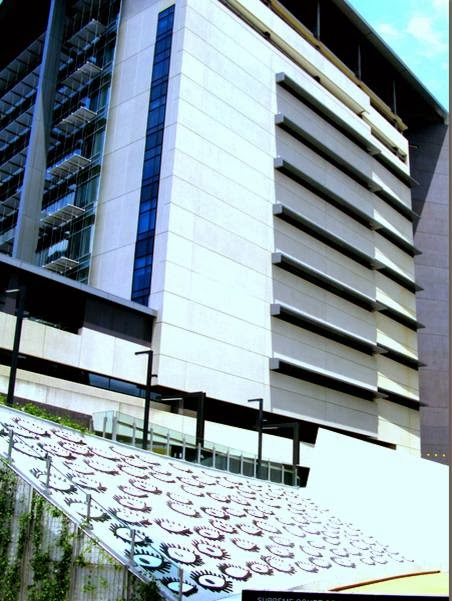
What makes a city? In the Philippines, a minimum annual income of PhP100 million pesos ($2.2 million) could get one its cityhood, thus if a town has a cement or steel factory, a bottling plant, a copra or sugar mill, they may just qualify. In Brisbane, the capital of Queensland, it could be a checklist of things. Not the least of which are the architectural structures arising from the land. I am into geometrical forms, curves and panels, cascades, play of colors, highways, gyms, murals, butterfly structures, sculptures, and skyscrapers. Of course there's the occasional flower here in there. I didn't have lofty expectations about Brisbane, but it didn't disappoint.

But really, more than these physical creations, it's the people who built, the people who conceptualized, the people who warmly smiled when asked for directions (or even when you didn't) - these are what makes a city!

In a series of photographs that accentuate architectural styles, here is my homage to Brisbane.

This is the Eye in the Sky!


Myers Centre (above and below)


Cinema Hall at the Myers Centre.


J. Seward Johnson, Jr.'s "Big Sister"

Brisbane's Story Bridge (above and below)