|
| Wat Phuang Kaew in the heart of Don Khong's main tourist drag. |
Wat Jom Thong is believed to have been constructed during the
Chao Anou Period (1805 to 1828). This temple complex sits at the bank of the Mekong in the village of
Wat Xieng Wang at the northern end of Muang Khong's main tourist drag. It's a comfortable walk from town, passing through rows of guesthouses, bamboo grooves, untended fields and a dramatically placed bridge before eventually finding the south gate entrance. The temple itself faces the east, shaded by coconut palm trees, some betel nut plants and a mango tree to its left. At the back of this main temple - the "
sim" (ordination hall) - is a newer, albeit smaller temple which is eternally closed for visitors, but nonetheless visible. The grills have been shaped in Buddha-like images.
Chao Anou Period was lead by
Chao Anouvong (Chaiya Sethathirath V) who led the Laotian Rebellion between 1826 to 1829. He was the last king of the Lao Kingdom of Vientiane. Anouvong succeeded his brother
Chao Intawong when the latter died. Anuvong was quite friendly with the Siamese regime. In fact, he helped Thailand in its campaign against the Burmese. He also repressed a Champasak revolt. He was also responsible for the construction of the beautiful
Wat Si Saket in Vientiane.
Wat Jom Thong is the island's oldest temple, but it's also famed for its unique cruciform pattern. However, it's easy to disregard this detail once you're inside. A dozen Buddhas of varying sizes adorn the main altar. Three concrete stand-alone arches with chipped off white paint stand right in front of the temple, each one facing the east, north and south. Roaming the grounds is an enjoyable foray back into time. After all, not many structures dated 1805 survive the modern age of cyber interaction.
Soaked with a rich atmosphere and the obvious desolation, nay abandoned feel, Jom Thong is one of my personal favorites.
 |
| Wat Jom Thong in Ban Xieng Wang |
 |
| Wat Jom Thong's main temple, the "sim" or ordination hall. |
 |
| Fronting the entrance of Wat Jom Thong, which faces the east, are 3 stand-alone archways facing north, south and east. |
 |
| The northern side of Wat Jom Thong. |
 |
| The southern side of Wat Jom Thong is the most common entrance of most tourists coming from the south's main tourist drag. |
 |
| The back of Wat Jom Thong. |
 |
| A second, smaller but more modern temple rises at the back of the main temple. |
 |
| Main "altar" of the second temple at the backyard. |
 |
| Wood carvings at the main temple's front door. |
 |
| Main altar of the ordination/prayer hall of Wat Jom Thong. |
 |
| Entrance gate of Wat Jom Thong from the southern entrance. |
 |
| Fields surrounding Wat Jom Thong. |
In the central town of Muang Khong,
Wat Phuang Kaew dominates with its sprawling grounds and a gigantic Golden Buddha facing the east. The statue itself sits on a pedestal rising from an 18-step platform guarded by
nagas (mythical water serpents) from each side. There are stupas at the front. Two main temple halls stand beside each other.
The main temple is the "
sim" (ordination hall). It boasts of a breezy hall beautifully designed with white posts on a square-tiled hallway filled with Buddha statues, a gong, a carriage, etc. In the chaotic era of political struggle during Laos' "
revolution", the government tried to oust the abbot governing the temple. Despite such power and influence, they were unable to do this. People have since believed that the head monk's powerful meditation had given him due supernatural powers to deflect the oppressive politicians, making this temple quite a bit of a local legend.
Since the temple stands smack in the heart of
Muang Khong, it is easy to visit anytime of day. It is located south of the bridge and the row of guesthouses. Nearby is an internet cafe with cheaper rates that open until 10PM. The Agricultural Promotion Bank is in the vicinity, so are the Police Station, Post Office, Lao Telecom, Governor's Office, Bureau of Finance and Office of the Poverty Assistance Fund. In front of the temple is an abandoned football field now covered by untrimmed grass.
There is a more romantic temple -
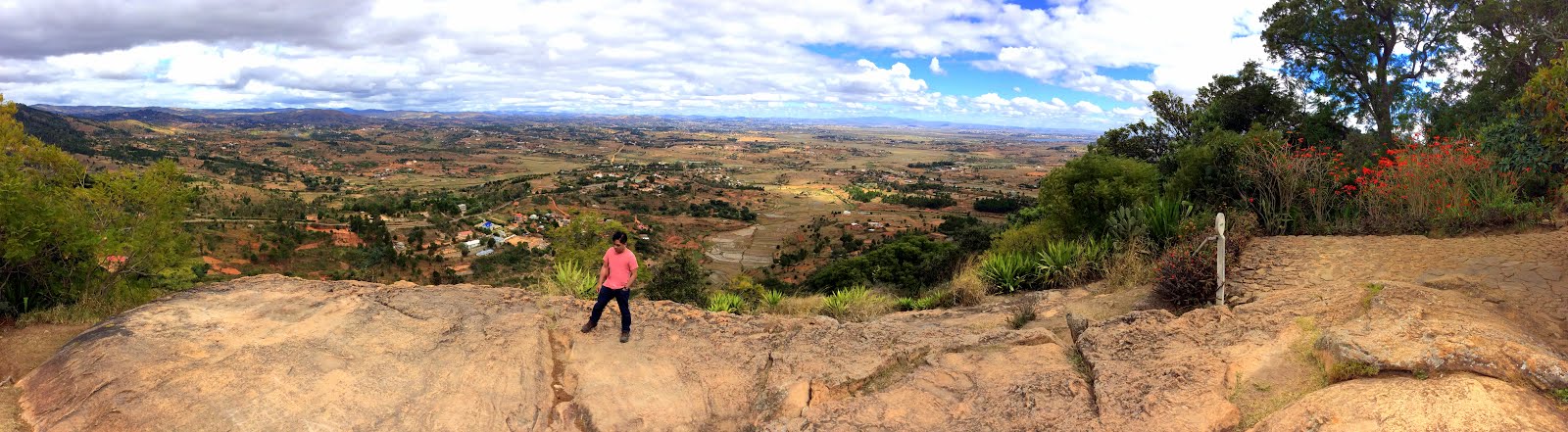
Wat Phu Khao Kaew - that sits on top of a hill at the western riverbank, in the
Muang Saen village 8 kilometers east from Muang Khong. This was something I wanted to see more than a traipse into the party island of Don Det. I knew I had to get there.
This is the
Eye in the Sky!
 |
| Wat Phuang Kaew's gigantic Golden Buddha being guarded by a naga. |
 |
| Wat Phuang Kaew's main temple. |
 |
| Main altar of Wat Phuang Kaew |
 |
| Spacious and atmosphere-rich ordination hall of Wat Phuang Kaew. |
 |
| Second temple in Wat Phuang Kaew grounds standing to the right of the main temple, but is mostly closed. |
 |
| Stupas in front of Wat Phuang Kaew's grounds. In front is a football field that's mostly deserted. |