Sometimes, the past doesn't serve us eye candies.
is it the safest. In fact, my mother warned me against seeing the area after 5 in the afternoon. Thus I visited Colon with a bit of trepidation. But surprisingly, Colon was far from this notorious impression. It enjoys a vibrant
bustle though it isn't not meant for tourist consumption just yet.
On the whole, Colon is the
poster child of
urban decay. It is also Cebu's version of
Quiapo, Sta. Cruz or
Baclaran. People are supposed to stay away after sun down - the way we're warned against New York's the Bronx, Hamburg's Reeperbahn or London's
Brixton area. It also reminded me of Delhi's Chandni Chowk. But Colon has an enthralling hum, and though congested, didn't really intimidate me. One could turn to a smaller street and find shops that have seen better days; or end up in a small store for a delicious meal at just P30.
FOUNDATION OF FIRST STREET
It was the urban center back in the 16th century. Colon Street, also known as Parian Street (the barangay or administrative borough is also called Parian), is the Philippines' oldest street. Upon the Spaniard's return to the Cebu islands in 1565 (where they found the preserved image of the Holy Child), they inaugurated this street. Their fleet was composed of sea vessels named San Pedro, San Pablo and San Juan. They were under the leadership of conquistador Miguel Lopez de Legazpi. Aside from the aforementioned description, Colon is also the shortest national road in the country, named after Christopher Columbus.

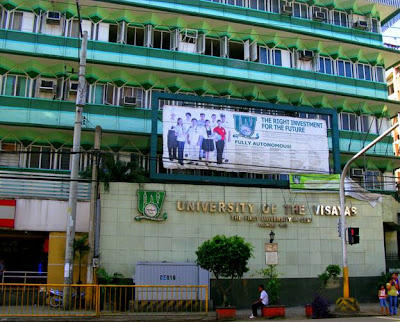
In the 60's and 70's, Colon was the site of fashionable shops, offices and movie houses. But fast times have meandered away from the area. The corridors turned shabby; the corners awash with crumbling pieces. Everywhere you look, there's a sense of bedraggled history, a spirit of a past in desperate need of resuscitation. The theaters that used to underline the throb of activity now stand decrepit, seedy and slovenly. In fact, these cinema houses are what my mother remembers about the area - huge marquees bathed in kleiglights. These days, Colon is run-down and the structures are mostly dilapidated. It still has shopping malls like Gaisano and 138 Mall; Cebu Business Hotel (Colon corner Junquera), and the University of the Visayas which was founded in 1919 (University of Santo Tomas - my alma mater - in Manila was founded in 1611). This university's six-storey main campus is scholastic home of some 20,000 students. As of this update (May 2014), more run-down shops have been taken down and turned into Metro Supermarkets and Gaisano Department Stores. There should be almost half a dozen (of Gaisano centers) already in the area.
MOVIE HOUSES
The movie houses that we've mentioned earlier still stand in varying states of neglect, except for the Oriente which, when we visited, was simultaneously showing the latest Hollywood and first-run Tagalog movies ("The Rise of the Planet of the Apes" and "Captain America"). At past 1 in the afternoon, these streets teem with manual and vehicular traffic, and the sidewalk gets filled with hookers; some of them openly ply their trade inside the movie houses, but they're quite conspicuous in broad daylight.
While the Oriente is being refurbished and repainted, Cinema Theatre has closed shop. New Eden Cinema, one of the better maintained theaters, was showing Seiko Films' exploitation flick "Sabik sa Halik" (P80 entrance). (As of this update, May 2014, Eden has been closed.) The same cinema, which opened in the late 50's, is notorious for blatant sexual cruising by its mostly male clientele. Just across Oriente is Vistarama showing Vince Tan's "Lamog". These movie houses are huge, compared to their modern day counterparts in Manila, but the seats are infested with parasites, bugs and roaches. They are also poorly ventilated. Elsewhere, restless souls wander away with the hopes of finding tricks for their daily survival.
NEW ATTRACTIONS
The Cebu Government is said to have big plans for Colon, envisioning a heritage walk for the area. In fact, they've erected a couple of new attractions: Colon Monument is a needle-inspired monument; a dour four-sided phallic symbol rising at the northeastern tip of Colon. A block away from here is the must-see Heritage of Cebu Monument along Mabini Street (the street at the northern tip of Colon). In the same street, you will find the Yap-San Diego Ancestral House which is a fascinating, albeit well-preserved residential ground, the oldest of such in the country. Further away is Casa Gorordo, a well preserved residence of an influential religious family.


The old city's version of Leicester Square adorned with huge billboards that are well lit at night.


New Eden Theatre opened in the late 50's. It has since been showing mostly adult local movies and even pirated Tagalog films. They even adopted the Philippine slogan "
It's More fun in Eden" last year which only invited further scrutiny. As of this update (May 2014), Eden has been closed.

Cinema Theatre. This theater opened after World War II. It has since closed shop. In 2013, the whole structure has been turned into a department store/supermarket.

Oriente Theatre was originally
Teatro Junquera (named after its adjacent side street) which opened in 1986. It was meant for stage plays but has since become a cinema. It has 3 screens. In the 90's, it was the first Cebu cinema to have employed Dolby Digital Surround. Such information taken from the Flickr's text of
fiscaplyder. Location: Colon corner Pelaez Street. As of this update (May 2014), it has re-painted its pediment to a more sedate color.

Vistarama Theater - Also called
Ultra Vistarama, it is listed as a gay cruising site, located at Pelaez Street of Colon, just across Oriente. It opened in the 60's and to date has been showing sexy films at just P80 admission price. With the closure of New Eden, Vistarama has become the only place for cruising. Female prostitutes used to roam the halls, but now it's mostly gay males. As of this update (May 2014), it's still operational.

University of the Visayas
 Another old building along Colon Street. This one houses a Lhuillier Pawnshop. Someone wrote to us about this. He says that this, and I quote, "...is actually the Vision Theatre that dates back to the 1930's. It was built by Agustin Jereza and the sculptures were done by Dante Guidetti."

Rabbits and puppies, as well as aquarium fishes, are sold along
Magallanes Street just before turning to Colon.


The street is decongested as you head towards the northeastern tip of Colon.


Cebu Business Hotel

Colon Monument