
Thailand folklore remains to be one of the richest source of the most colorful characters and legendary romances. I am particularly enthralled by the story behind the Garden of Pha Daeng in Nang Ai. Secret trysts, beautiful maidens, Naga princes and mysterious squirrels... oh gosh! Please read the story capsule below. This garden is on display in Ancient Siam in Samut Prakan. Though this statue is particularly easy to miss (it is situated at a lake as your tram gets near the south exit of the main park), you should stop and take a close look as a giant snake-like multiple-headed creature called a Naga chases over horse-bound lovers - and be aware of the story behind these star-crossed lovers!
In this 3rd and final part on Ancient Siam, aka Muang Boran - we also feature some sights from everyday-Samut Prakan. This is the Eye in the Sky.
 Thai Junk refers to a ship rustically built of wood with a combination of traditional details and modern technology. It doesn't refer to a "garbage"! So when you hear, "We're going to the Ayodhaya Junk" - you're actually going to a SHIP, not a garbage dump!
 Phra Chedi Si Song Rak in Loei - Phra That Si Song Rak was built in 1560 A.D. as a symbol of friendship between Somdet Phra Maha Chakkaphat of Ayutthaya and Phrachao Chaiya Chetthathirat of Lan Xan, the two kings. It was at this spot that the two kings vowed not to invade each other's territory. Instead they decided to unify their armies so that they could fight as one against the invading army from Burma. This unique temple symbolizes friendship and unity. Moreover, visitors visiting the temple should be careful not to wear red or offer red flowers, as red symbolizes violence and blood.
 Garden of the Gods - half-man, half-snake proudly stands by the lake.
 Garden of Pha Daeng in Nang Ai - Behind this eye-catching series of statues is a suspenseful tale that has become a personal favorite. The story centers on the romance of a lovely maiden and a ruler.
Nang Ai, the most beautiful girl in Khomkham City, had secret trysts with Pha Daeng, the ruler of Phaphong. Her celebrated beauty was unparalleled. This news eventually reached the son of the Naga king. The Naga prince, transformed himself into a very handsome gentleman and tried to seduce her, but he did not succeed in winning her heart. Finally, he then disguised himself as a white squirrel with intent of kidnapping her from Pha Daeng. When Pha Daeng and Nang Ai saw the squirrel, they ordered a hunter to trap it. The prince, in the guise of the squirrel, wa killed by the hunter. And the meat of the animal was fed to the towns folk.
Strangely, the squirrel's meat kept growing even though much of it had already been sliced off and distributed to feed the people in the city and neighboring towns. Suddenly, a huge rainstorm struck the town. The loving couple became suspicious. Pha Daeng scooped Nang Ai on his horse and they made a dash away from the city, but in vain. Nang Ai fell off the horse and slid into the river. The waters mysteriously overflowed, spilling into the city, flooding every nook and cranny. The spirit of the dead squirrel morphed into the king of Naga, taking Nang Ai into his underwater kingdom. It was said that those who had not eaten the meat were saved from the tragic event. Muang Boran constructed a group of statues based on the legend of Pha Daeng and Nang Ai. See first photo above for the folkloric escape of the ill-fated lovers from the Naga King.
 Even an ordinary rice field has its place in Ancient Siam, like this Udon Thani greens.
 The Temple of Prasat Phra Wihan in Si Sa Ket sits on top of a hill. I was too tired to finish off my visit with a climb up on a hill so I regretfully missed it!
 The Garden of phra Aphaimani in Rayong
 The Bell Tower
 Chedi of Cham Thewi in Lamphun
 The Garden of Sacred Stupa
 Garden of Phra Aphaimani in Rayong
 A footbridge to get to the highway - Sukhumvit Road. People actually fish from this "canal".
 Fishing off this canal - a creek that runs the length of Sukhumvit Road.
 Very clean roads - Kilometer 33 Sukhumvit Road in Samut Prakan. This photo was taken from the overpass.
 My bus ride back to Bangkok. An hour's travel... and the soothing blow of cool air.
For the complete narrative detail on my visit to the Ancient City, please visit the two previous posts.
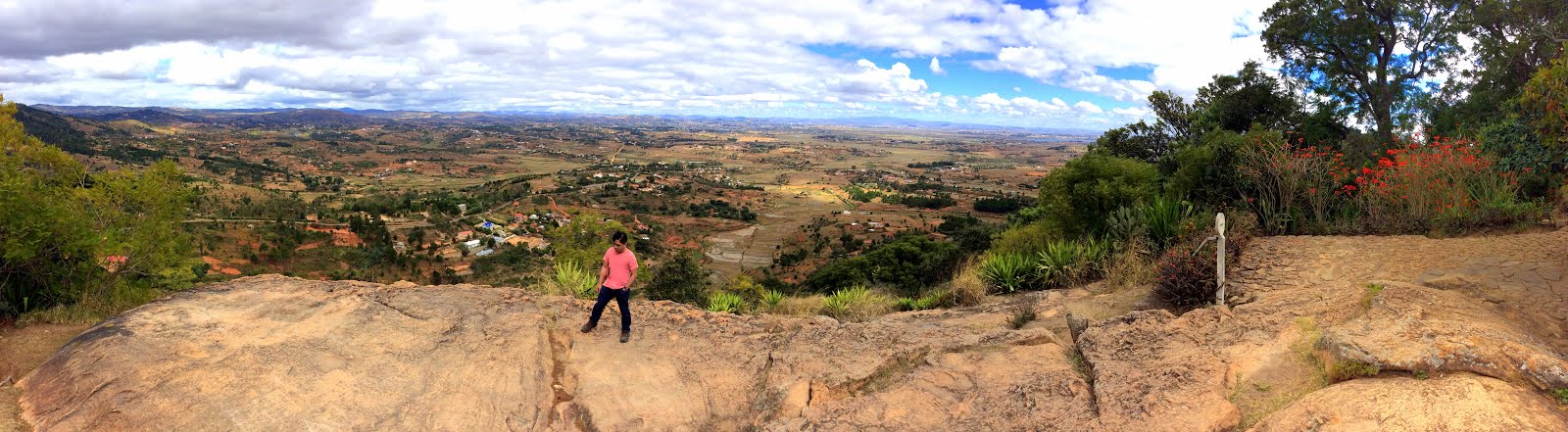
This is the Eye in the Sky!
More photos: Ancient City Part 1 of 3 - http://eye-in-the-blue-sky.blogspot.com/2009/08/ancient-siam-around-thailand-in-day.html
More photos: Ancient City Part 2 of 3 - http://eye-in-the-blue-sky.blogspot.com/2009/08/ancient-siam-around-thailand-in-day_11.html
For an introduction: Getting to Samut Prakan or step by step instructions on how to get lost (wink!wink!) - http://eye-in-the-blue-sky.blogspot.com/2009/08/long-road-to-samut-prakan-introduction.html


