
One of the joys of visiting Cebu is its relatively laidback demeanor. It doesn't have the frenetic pace of Manila, and the people take their time to smile. At one point, when I felt I needed someone to point me to the right direction, three different persons who overheard my query came over for help. One of them even crossed the street with me and hailed the correct number of the jeepney I was to take (Cebu's jeepneys are number-coded, each one is assigned a specific destination). The funny thing was, I just needed confirmation for the direction.
The Provincial Capitol is the seat of the provincial government of Cebu located at the northern tip of Osmena Boulevard. It is locally renowned for its similarity to the United State's White House. It was designed by the Filipino architect responsible for the stately Manila Metropolitan Theater (1935), the National Museum of the Philippines (1926) and the grandiose Manila Central Post Office (1926) - Juan Arellano. Construction started in 1937 under the administration of Governor Sotero Cabahug (with approval from President Manuel L. Quezon), and completed after a year. However, it was badly damaged during World War II. It was eventually rehabilitated under the Tydings War Damage Act of 1946.
Presently. two statues flank the facade. To its left is Lapu Lapu, the hero of the Battle of Mactan who fought against Ferdinand Magellan's fleet. To its right is Sergio Osmena Sr. who served as the 4th President of the Philippines from 1944 to 1946. He succeeded President Manuel L. Quezon.
 Sergio Osmena Sr. - 4th President of the Philippines, and the first Cebuano President.
 Lapu Lapu
"Our Lady of Mount Carmel" is the title given to the Blessed Virgin Mary in her role as patroness of the Carmelite Order. The first Carmelites were hermits living in Mount Carmel in the Holy Land. This parish was founded in June of 1621 in the heart of the old city, right across Carbon Market, along Magallanes Street. To get inside this huge church, you have to take the stairs at the left side of the entrance. Spacious and breezy, the green windows impart the interiors a dramatic atmosphere. It's one of my favorite discoveries. Since 2006, this has been under the care of Father Urbano Galanido. It can accommodate 1,200 people.
 Our Lady of Mount Carmel Parish - Recoletos


 University of San Jose - Recoletos is a private Catholic university founded in 1947 by the Order of Augustinian Recollects. The Parish of Our Lady of Mount Carmel is located beside the University. Right across this is Carbon Market.
Carbon Market is the biggest and oldest farmer's market in Cebu City. As of 2009, it was over 100 years old. It got its name from the depot where coal was unloaded from the Cebu Railroad which has been decommissioned long time ago. Check out this site for reference: http://lagunarailways.rihspi.org/2008/01/cebu-train.html
Carbon Market is easily reached on foot from the Santo Nino Basilica and Magellan's Cross.


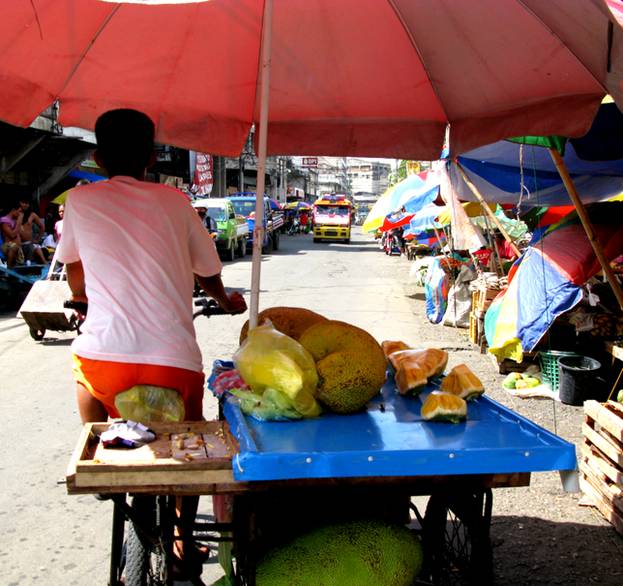 Ambulant vendor peddling his jackfruit.
 A truck full of fresh produce at the Carbon Market.
 Street food
 Sleeping on the job.
A respite after a couple of hour's walk, I chanced upon a Dunkin Donuts' shop. With Iced Coffee, a bavarian donut feeds the hungry and tired.

 A busy corner at the Cebu Midtown Hotel, facing Osmena Circle. Apurado Restaurant sells lechon and barbecue, and other gastronomic items Cebu is known for, with mid-range prices.


